The organisers of a walk last Sunday along the Marsalforn valley have highlighted that “the public outcry is increasing against the Victoria-Marsalforn road project.”
“Growing outrage” against the proposed Triq Marsalforn road-widening project led over 50 people to attend the guided nature excursion into Wied tal-Grazzja on Sunday, organised by Malta-Arch and Flimkien ghal Ambjent Ahjar.
Enthnobiologist Timothy J. Tabone led the group down the country road that is to be widened and straightened, “uprooting over 230 trees and destroying much agricultural land and natural habitats in the process.”
During the walk, Mr Tabone identified many threatened indigenous trees, including the Narrow-Leaved Ash (Fraxinus Angustifolia) and the White Poplar (Populus Alba).
According to the organisers, “these trees, among Malta’s most highly-protected, were not indicated on the landscaping plans submitted by the Ministry for Gozo and approved by ERA.”
They pointed out that “these large old trees dominate the landscape, and it is hard to understand how the Ministry for Gozo or ERA could have missed them.”
The organisers said that “outrageously,” the ERA screening concludes that the project did not require an Environment Impact Assessment, as it provided no “significant environmental impact.”
They argued that “needlessly widening the road will have a huge environmental impact. These trees play a critical role in filtering out air pollutants and combating Climate Change. The project will also destroy rare natural habitats for threatened species. Finally, removing the trees and green spaces threatens the physical, mental, and emotional well-being of Gozo’s residents.”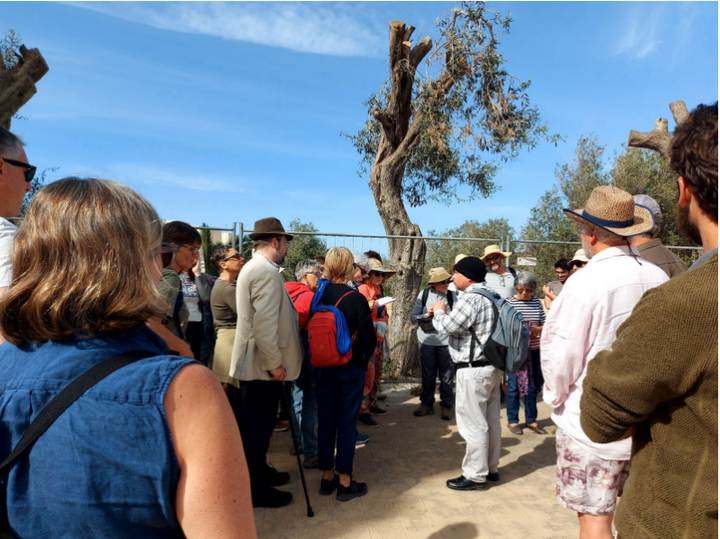 As Timothy Tabone guided the walkers into Wied tal-Grazzja, he explained how the project would devastate habitats critical to indigenous species, such as the Moorhen – an endangered waterbird. Rare plants, such as the Bulrush (Typha domingensis) and Sea Clubrush (Bolboschoenus maritimus), are also of grave conservation concern.
These species grow near flowing freshwater streams (a scarce resource in Malta and Gozo) making them especially vulnerable to the road-widening project.
It was explained that even if their habitats are not completely wiped out, the influx of heavy vehicles, machinery and construction materials poses threats to their survival when their protection should be a top priority.
Mr Tabone also shared fascinating stories connecting the plants to Maltese heritage and folklore. For instance, the ‘fluff’ of the Bulrush (Scirpoides holoschoenus) served to bind wounds. The Mediterranean Star Thistle (Centaurea nicaeensis) or ‘Xewk tal-G?otba’ was widely employed to treat Brucellosis.
Meanwhile the White Hedge-Nettle (Prasium majus), also known as ‘Te Sqalli,’ was historically used as a tea substitute by poor communities, especially during World War II. Additionally, non-indigenous plants like the Loquat fruit trees (‘Naspli’) played important roles in providing food.
Furthermore, Tabone delved into the origins of archaic Maltese words that drew from such plant names, illustrating how public memory and the language itself is intertwined with nature. Such linguistic heritage increases the imperative that our natural sites remain untouched.
The organisers said that during the meeting held after the nature walk, “members of the public condemned the road project criticising its lack of transparency and accountability from the start. People expressed particular outrage over the fact that the €9 million tender was awarded to Prax Ltd – a company owned by Nadur developer Joseph Portelli and his close Gozitan associates – years before the permit was even issued.”
Additionally, they argued that “the claim that the road was being reconfigured to improve safety, was belied by the police confirmation that the road does not have a track record of serious traffic accidents or congestion.”
Everyone at the meeting agreed that the road is never congested and that the claim was “a mere cover-up designed to funnel more money to the developers,” the organisers said.
They also insisted that “the additional justification from the government that the road needs to be upgraded to match European Trans-European Transport Network (Ten-T) standards is ludicrous as this applies to major trade routes, clearly not the case with Marsalforn.”
Furthermore, the organisers highlighted that “this project, co-financed by the European Union, blatantly contravenes EU measures aimed at combating climate change. It destroys countryside at a time when millions of euros are being allocated to return land to the wild.”
M-A and FAA concluded by saying that “all those present at the meeting strongly condemned the Government’s decision to squander €9 million on a project that not only destroys nature, but also undermines tourism. This so-called “upgrade” would transform an idyllic road and landscape into a dangerous motorway serving no one’s interest, other than the developers and their political cronies. It must be halted immediately.”
Photos: Malta-Arch and Flimkien ghal Ambjent Ahjar
4 Comments To "Public outcry increases against Victoria-Marsalforn road project – NGOs"
#1 Comment By Anna Wright On April 25, 2024 @ 12:45 am
There are a lot better uses for 9 million euros than this unnecessary road widening. What about planting more trees, more projects to preserve water, increased funding for Malta Rangers, Birdlife Malta, Nature Trust and other projects that protect Gozo’s beautiful natural heritage rather than destroying it.
#2 Comment By Rose Buhagiar On April 25, 2024 @ 4:27 pm
Wholeheartedly agree with this comment for spending money to preserve, protect, & fund versus destroying! Well said Anna!
#3 Comment By Susan Mills On May 6, 2024 @ 6:07 pm
As a tourist to this beautiful island for over 30 years I have seen good building and bad building, your island is being ruined and when the beauty is obliterated with concrete one day the tourism will stop
#4 Comment By Juri T On May 6, 2024 @ 9:26 pm
Yes the good buildings are from old times, made by master builders.
There is no breathtaking contemporary architecture on these islands.