 An international meeting on Islamic Finance held in Malta examined the main advantages of the country acting as a centre for Islamic Finance in the Mediterranean. Participants agreed that Malta was strategically well-positioned to act as the “Bahrain in the Mediterranean,” from where Islamic Finance Institutions may reach and penetrate the markets of the European Union and North African.
The event, held between the 12th and 16th of October 2009 at the Radisson Blu in St Julians, was organised by the Malta Institute of Management in collaboration with the Malta Union of Bank Employees and the Malta Employers Association. It was made possible through the co-funding of the European Union funding programme Grundtvig and the collaboration of Bank of Valletta, Path Solutions, Newtech of Demajo Group and Erremme Business Advisors.
The five-day event, based on daily workshops, attracted world renowned speakers such as Dr Mohammed Nedal Alchaar, Dr Hussein Hamid Hassan, Prof Abdulla Al Shami, Mr. Reuben Buttigieg, Mr Nazmi Camalzaman and Mr. Oliver Agha. The delegates were from throughout the European Union and elsewhere, including Italy, Luxembourg, Latvia, the United Kingdom, Turkey, Malta and Slovenia.
The first session concentrated on an overview of Islamic Finance and its potential in Europe and the Mediterranean. The other four days addressed different pillars of Islamic finance, including Insurance, Banking, Funds and Sukuk and Islamic Capital Markets. The workshops were chaired by different personalities including Malta’s Dr Max Ganado, Mr Francis J Vassallo, Mr Peter Grima and Mr Reuben Buttigieg.
The main advantages that were identified with regards to Malta’s potential as a centre for Islamic Finance in the Mediterranean were the following: it is Geographically Well-Positioned to serve various Mediterranean countries; it has an Extensive Network of Double Taxation Treaties that mitigate the tax effects of certain legislations on Islamic finance transactions; it provides Unique Opportunities such as the Double Taxation agreement with Libya; it is the First Jurisdiction that is thinking of a centre for Islamic Finance in the Mediterranean; it is a Reputable Financial Services Location; it has a Reputable Regime in terms of banking, funds and insurance; it has a Huge Potential for Special Purpose vehicles; it has a Trust and Trustees Legislation; it can provide customised solutions – For example Malta can cater for small funds which no other EU jurisdiction can; it is considered by the World Economic forum as the 10th Safest Country to invest in; it has Excellent Relations with all EU countries and North African countries
During the workshops various structures were considered particularly vis-a-vis Italy, Malta and Spain. The Malta formula was seen as a potential vehicle to assist Muslim Communities and Investors in these countries to have the alternative financing they require. The opportunity of Borzamed as a Mediterranean platform for Islamic Capital Markets was also discussed.
The legislation of Malta was analysed and various views were discussed on what can be done through Malta. It was felt that the main issues are tax-related and not legislative issues as the perception in some quarters may be. Examples were mentioned, among them that of the Valetta Investment Bank which had products that in essence can be identified with Islamic Project financing. The Middlesea Insurance and APS Bank were also constantly brought forward as being organisations that in the past had some sort of activities that were similar to Financing. It was argued that Malta is not new at all to certain type of transactions. What happened was that Malta’s tax laws have rendered such transactions as not feasible.
The robustness of Islamic Finance was also analysed. It was concurred that had Islamic Finance been predominant in the world, the Financial Crisis would probably NOT have happened. The recession was felt also by Islamic Finance since, for example, it also affected the property market. However, the crisis has shown that this alternative method of finance is definitely sound possibly much more than the conventional finance.
In his concluding remarks, Mr. Reuben Buttigieg as Chairperson of the MIM Education arm, promised to continue working hard towards the development of Islamic Finance in the Mediterranean. He expressed the hope that local politicians, who showed enthusiasm about the potential of Islamic Finance in Malta, manage to generate enough commitment from the authorities concerned to ensure timely implementation and marketing. Mr. Buttigieg said that Malta’s competitors, such as Luxembourg, Cyprus, Guernsey and Jersey are flourishing with Islamic Finance structures. It would be a pity if Malta misses such big opportunities.
Mr. Buttigieg augured that the current economic scenario does not hinder the Government from actively appreciating these opportunities in good enough time. He also encouraged Maltese professionals who appreciate the advantages of Islamic Finance to start making use of the current legislative structures, while backing the appeal to government to ensure all appropriate action required so that Malta does not miss the bus concerning the opportunities offered by Islamic Finance.
Given the success of the event, the Malta Institute of Management was invited to organise a similar event in Italy and in Spain.
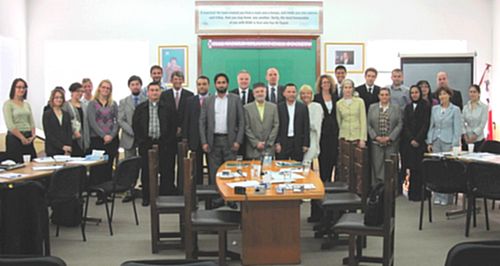
Photo shows Some of the participants and speakers during last day of workshop
1 Comment To "Islamic Finance experts see Malta as a potential “Bahrain in the Mediterranean”"
#1 Comment By Franco J Scicluna On October 22, 2009 @ 12:24 am
Yes, what was said above is all true.Malta does indeed have the required potential, to be the Bahrain of the Med. What it needs now is to bring our OIL to the surface. I know its there, but maybe there is a hidden agenda behind it.