Luke Said, PN candidate for Gozo, has highlighted the fact that “the best atmospheric monitoring station in the country – Ta’ Gordan Research Station – has been switched off for 2 and a half years just because the road to it has not been finished. A truly sad state of affairs, scientist left waiting for the project to finally finish.”
In a statement, Said stressed that “although this research might feel irrelevant to most of us, climate change and more extreme weather (As evident from Storm Harry) as a result of climate change necessitates far more atmospheric studies, yet the government doesn’t seem to be worried.”
He explained that Ta’ Gordan lighthouse has served as a site of guidance and safety for generations. Historically, it functioned as a navigational aid for maritime traffic. In recent decades, it has acquired an additional and internationally significant role as a scientific monitoring site contributing to global atmospheric research.
Located on Gozo’s north-western edge, Ta’ Gordan lighthouse hosts one of the most important background trace gas monitoring stations in the Mediterranean region.
The station was conceived in the early 1990s by the University of Malta in collaboration with the Max Planck Institute for Atmospheric Chemistry. It was established to monitor ozone, carbon monoxide, sulphur dioxide, aerosols, and a comprehensive range of meteorological parameters.
Luke Said noted that in 2000, the station was granted official status within the United Nations Global Atmospheric Watch (GAW) programme, placing Gozo among a limited number of internationally recognised monitoring locations. Its geographical position, between Europe and North Africa and adjacent to one of the world’s busiest maritime corridors, makes it uniquely suited to measuring long-range pollution transport, shipping emissions, and regional atmospheric and climate dynamics in the Mediterranean basin.
Said pointed out that “this infrastructure represents a high-value scientific asset. It supports international collaboration, contributes to global climate datasets, sustains specialised research activity, and anchors local scientific expertise within global research networks. It is also fully aligned with repeated policy objectives to attract knowledge-based, future-oriented sectors to Gozo.”
He stated that “despite this, the monitoring station was effectively non-operational for approximately two and a half years. This was not the result of scientific shortcomings, funding constraints, or withdrawal of international partners. Operations ceased because access to the site was compromised by an unfinished road leading to the lighthouse.”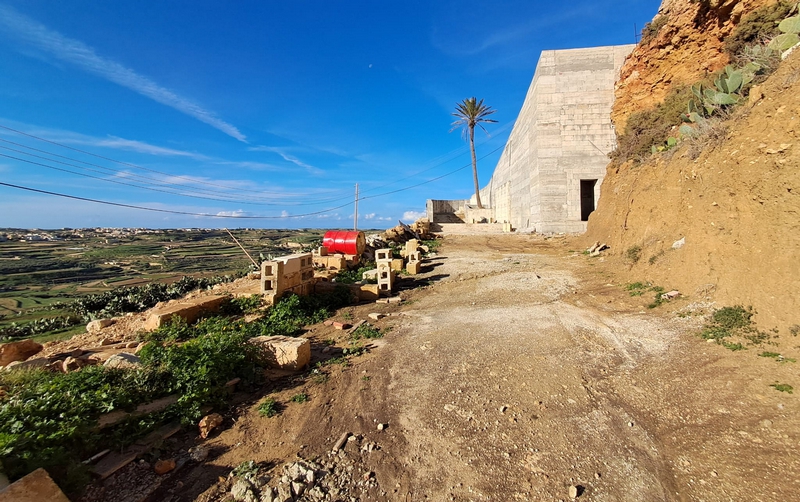 Said went on to say that the instruments installed at Ta’ Gordan require regular physical access for maintenance and calibration. “Without such access, reliable operation is impossible. As a result, years of continuous atmospheric measurements were lost. In climate and atmospheric science, continuity of data is critical. Interruptions permanently reduce the scientific value of long-term datasets and diminish their usefulness for trend analysis, modelling, and policy-relevant research. The loss incurred is scientific, reputational, and strategic.”
Luke Said insisted that “this situation is particularly concerning in the context of recent extreme weather events affecting the Maltese Islands, including Storm Harry, which caused flooding and infrastructure damage only days ago.”
He added that “such events are becoming more frequent and severe. Atmospheric monitoring is essential for understanding pollutant behaviour, aerosol dynamics, and energy exchange processes that influence storms, heatwaves, and precipitation patterns in the Mediterranean region.”
Stations such as Ta’ Gordan allow researchers to identify long-term trends, detect anomalies, distinguish between local and transported pollution, and assess the atmospheric impacts of maritime activity, stated Said. “When these monitoring capabilities are suspended, decision-makers and researchers alike are deprived of critical evidence needed for preparedness, planning, and resilience.”
That is why the answer given by Gozo Minister Clint Camilleri is more frustrating. In early January the Minister was simply asked in PQ 33440;
“Jista’ l-Ministru jghid x’inhi r-raguni ghad-dewmien fit-tlestija ta’ Triq il-Lanterna (it-triq li twassal g?all-fanal tal-Gordan), u meta huwa ppjanat li jitlesta l-progett?”
In which he responded by;
“Ninforma lill-Onorevoli Interpellant li l-parti d-dejqa ta’ din it-triq kienet qieghda iccedi u saru l-interventi necessarji ta’ piling u rinfurzar sabiex dan ma isehhx.”
Two and a half years later, and still no end in sight!
Luke Said noted that “the circumstances surrounding the inactivity of the Ta’ Gordan station highlight a broader governance failure. Long-term scientific infrastructure does not lend itself to short-term political visibility, yet its importance is substantial and enduring. Allowing an internationally recognised research facility to fall inactive due to unresolved basic access issues reflects administrative neglect rather than unavoidable constraint.”
He said that “Gozo has consistently articulated the need for economic diversification beyond seasonal and low-value activity. The Ta’ Gordan monitoring station represents a concrete example of such diversification: world-class science embedded locally and connected internationally. Its interruption undermines both scientific objectives and broader development goals.”
Luke Said concluded by saying that “Ta’ Gordan lighthouse once guided vessels through darkness and storms. Today, it supports efforts to understand a rapidly changing atmosphere and climate. That this function was compromised by an unfinished access road constitutes a failure of governance that warrants acknowledgement and corrective action.”
Photos: Luke Said