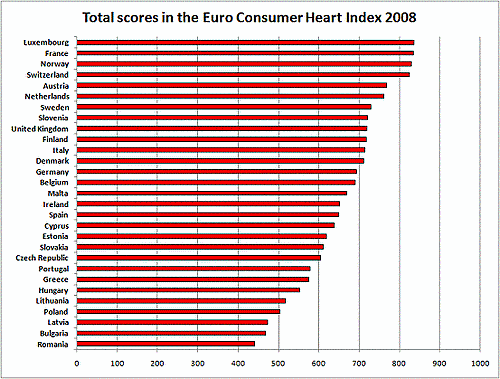
At the launch of the First Euro Consumer Heart Index in Brussels today, the Maltese performance ranked 15th out of the 29 participants. Luxembourg leads with a score of 836 points, followed by France, Norway and Switzerland. The Heart Index compares the care systems around Europe from a consumer point of view. In five categories, covering 28 performance indicators, Malta scored 670 points out of a potential 1,000. A graph comparing all countries is shown at the bottom of this page.
“Malta has an excellent access to care. The brand-new state-of-the-art Mater Dei hospital should provide the opportunity to attain world class standard but the results are not really visible yet.” says Dr. Arne Björnberg, Research Director for the Heart Index.
What more could be done on Malta?
“The power-balance in cardiac care would gain from letters from specialists to GP:s being copied to patients, for information and dialogue.” states the President of the Health Consumer Powerhouse, Mr. Johan Hjertqvist, when analysing the Index outcome implications for Malta.
About the Heart Index
The Euro Consumer Heart Index provides a ranking of European cardiovascular healthcare systems across five key areas to the consumer: Information, consumer rights and choice, Access, Prevention, Procedures and Outcomes. The Heart Index is constructed from public statistics and independent research. The producer of the Heart Index is the analysis and information organisation Health Consumer Powerhouse. As with all the other Indexes it produces, HCP takes a consumer-centred position. The Heart Index is produced with the help of an unrestricted grant from Pfizer.
Malta’s status in the Cardiovascular Index:
Information, consumer rights and consumer choice
Patients seeking cardiovascular healthcare in Malta have the benefit of a good choice amongst health care professionals on a national level and also the right to receive patient letters directly from hospital rather then having them bypassed to their respective GPs. In the area of information on cardiovascular health care providers, Malta tends to score low points since Malta only has one centre for acute cardiovascular healthcare and therefore no league tables can be produced. Policies regarding access to cross border cardiovascular healthcare across the EU are still being developed, however the Health Consumer Powerhouse had previously lauded the agreement Malta holds with the UK regarding exchange of healthcare services as a good example of cross-border cooperation that should be implemented across Europe.
Access
Malta scored top points in all indicators related to access to cardiovascular healthcare. These indicators were related to the number of centres per million persons with 24 hour PCI, same day access to doctor for chest pain, same day access to diagnostic techniques for acute presence of suspected heart disease and waiting times for non-acute bypass/PCI.
Prevention
Malta’s programmes on smoking cessation and restrictions score very well in comparison with EU counterparts. Also in relation to patient CVD screening and fruit and vegetable consumption the Maltese population scores within +/- 10% of EU average indexed rate meaning an average level in comparison with other EU countries. Unfortunately scores related to percentage of obese people and the number of hours of physical activity in schools; continue to highlight the problems experienced by the Maltese population in this area. Malta also lacks nationwide data on mean systolic pressure for the population and this could be reconciled if a health examination survey was initiated to collect such representative data. Unfortunately, the last health examination survey in Malta took place in 1984 and this highlights the need for a repeat survey to be carried out.
Procedures
Malta gained high scores on indicators related to the distribution of statins and the availability of pre-hospital thrombolysis. Intermediate scores were obtained for indicators related to “Call-to-ambulance-arrival-at-patient’s-home” time at an average of 12 min (however with 19% of cases being answered within 8min) and percentage of patients with a heart attack admitted for PCI at 43.6%. Low scores were obtained for indicators related to percentage of these patients who get thrombolysis. However, the local treatment protocol prefers PCI to thrombolysis and this could explain the low figure on thrombolysis. In addition, automatic defibrillators are still not available in public areas. No data was available for the indicator related to door-to-needle time and also distribution of clopidogrel within the population as there is no access to information on private consumption of medications and this medication is only available through the private sector.
Outcomes
Scores for indicators on rehabilitation programmes and mortality rates were intermediate, including the ischaemic stroke 30-day case fatality rate at €10%. In relation to the 30 day hospital-based case fatality following heart attack, one must note that apart from scoring the highest points possible Malta had a considerably lower percentage rate in comparison with the EU average with 2.2% as opposed to the 8.2% for the EU.