The Environment & Resources Authority has said that a new endemic species has been described as from the Maltese Islands – this being unique to our islands.
Known as the Maltese Ferule or il-ferla in Maltese, this species has been first described scientifically as Ferula melitensis, in the recent scientific publication, Phytotaxa, published on the 10th of December
The ERA explained that this species is unique to the Maltese Islands; and hence is endemic and differs significantly, both morphologically and genetically from the other European and African ferule species, but showing closer links with the Tunisian Ferule (Ferula tunetana), which is also absent from Malta.
The Tunisian and Maltese Ferules were both originally thought to be the Common Ferule (Ferula communis), with which our new species was previously confused, the ERA added.
It added that essentially, the Maltese plant is stockier than the Common Ferule, which is absent from Malta, with clear differences in the leaves, flowers, flowering period, fruits and seedlings.
The species is quite common in Malta, where it grows in different soils and habitats, including local xaghri, fallow or abandoned fields, countryside road verges and xeric grasslands (these being typical of the very dry climate).
The species was traditionally used for the treatment of dysentery or the treatment of skin infections, the ERA said. “However, such uses are discouraged, as the plant can be poisonous if inappropriate dosage is employed,” it warned.
In addition, dried stalks were used to sharpen razor blades or as a substitute of ‘firewood,’ with the dried pith was sometimes also used as a slowly-burning tinder.
According to the ERA the ferules are also known to produce compounds that have diverse pharmacological effects, including antibiotic/antimicrobial and compounds used in the treatment of cancer. It said that the medicinal potential of these compounds is considered as high, with ferulenol being considered as a lead compound in drug discovery.
Apart from the intrinsic value of a new species unique to the Maltese Islands, this species also sheds more information on biogeography (the study of the distribution of species and ecosystems in geographic space and through geological time), in that they confirm the North African affinity of some of our unique flora, said the ERA.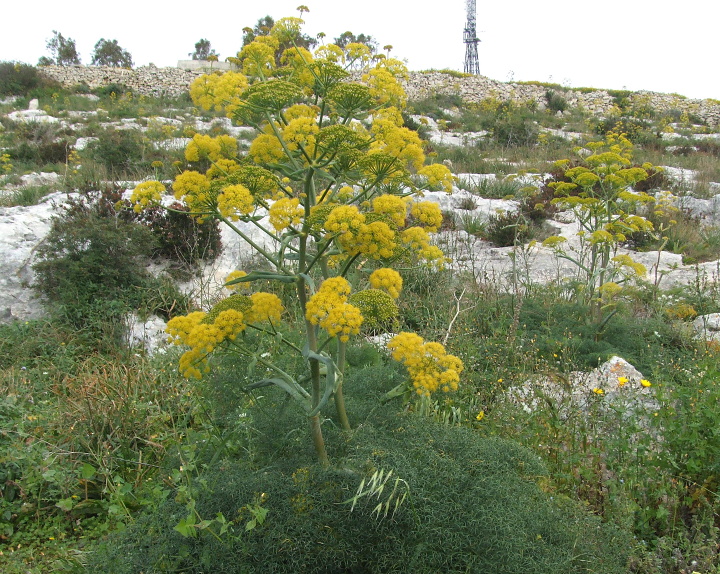 The origins of the Maltese Ferule are currently assumed to be due to geographic isolation from North Africa as a result of alternating sea-levels in the period between 5.96 to 5.33 million years ago.
This is not the first plant species to confirm such link, explained the ERA, since many unique endemic Maltese species show North African affinities, like the Maltese Salt Tree (Darniella melitensis; is-sigra tal-irmied) and the Maltese Fleabane (Chiliadenus bocconei; it-tulliera ta’ Malta).
The Maltese Fennel is a recent discovery from 2018; confirming the recurrent need of obtaining more information on Malta’s native and endemic biodiversity.
The ERA said that the find was made by a team from the Universities of Catania, Palermo and Cagliari, with the lead of Professor Salvatore Brullo of the University of Catania. Prof. Brullo is a lead botanist in the Mediterranean region, and is well renowned in local botanical sphere as he has studied and described many Maltese endemic species.
The Authority pointed out that the Maltese Ferule and many endemic species are protected in terms of the Flora, Fauna and Natural Habitats Protection Regulations, under the Environment Protection Act.
Should more information be required on permitting considerations, more information is available online by clicking here [1].
More information on the Maltese Fennel can be found in this publication by Brullo [2] et al (2018).
For further information kindly contact national.affairs.era@era.org.mt [3]