Following an Outdoor Classroom activity at Hondoq Bay by students of Gozo College Middle School in November, [1] the students carried out an investigation about the effects of plastic on sea water temperature and pH value.
The aim of all the students is to reach out to the general public and pass on the message that litter, especially plastic, is not just causing an eyesore but affecting the marine ecosystem.
These students have now detailed what they did and what was discovered during these investigations.
Litter is found in all the world’s oceans and seas, even in remote areas far from human contact and obvious sources of the problem.
“According to the International Maritime Organisation (IMO, 2020), marine litter presents a huge problem in our oceans, with some scientists warning that, by 2050, the quantity of plastics in the oceans will outweigh fish.
“Plastic materials in all shapes and sizes can break down extremely slowly in the marine environment, taking over 400 years (Reddy et al, 2018).
“Marine litter originates from many sources and causes a wide range of environmental, economic, safety, health and cultural impacts. For example, marine litter can cause harm to sea life if ingested or even death if a marine mammal becomes entangled in litter (PEW, 2018).
“But there other consequences as a result of all this litter ending up in the oceans and seas. Does plastic affect sea water conditions?
This study investigated the effects of marine litter, especially plastic, on sea water.
Following an outdoor classroom activity held at Hondoq Bay, the students decided to investigate the effects of plastic litter on sea water temperature and sea water pH levels.
Taking some sea water to school, two large glass jars were filled with the same amount of sea water. Some plastic litter collected during the clean-up activity was put in one of the jars. The glass jars were placed outside exposed to the sun and rain.
Every day three readings of the sea water temperature and pH level from both jars were taken by the students. The mean of the three samples was calculated.
Moreover, the air temperature, humidity and air pressure were measured and cloud cover observed using the GLOBE Observer App, also describing the general outlook of the weather.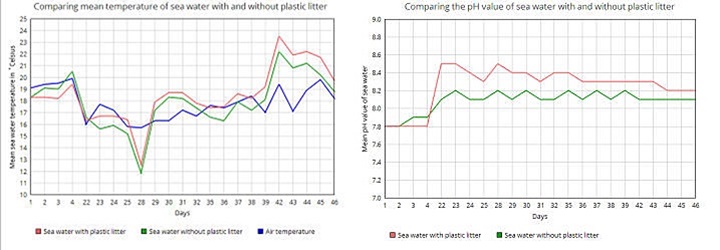 All data gathered was analysed through comparing mean values pH and temperature between the two jars, with plastic litter and without. The mean values were plotted along time to verify the changes between both situations.
Finally, the mean values were further analysed, with the help of a scientist, using a paired sample-t test, to verify meaningful differences between the two conditions and pH and temperature. Once all data was collected the data was presented in a graph.
Conclusions:
For the glass jar filled with sea water and plastic litter, the average sea water temperature was 18.50 degrees centigrade and the pH level of 8.24.
On the other hand, the glass jar containing just sea water showed an average sea water temperature of 17.93 degrees centigrade and a pH level of 7.37. The sudden drop in sea water temperature on day 28, in both jars, can be attributed to the fact that on that day it rained.
In fact, that was the only day rain was reported during the whole observation period. Correspondingly the pH level, on that day, increased in both jars. On average, air temperatures were around the mean with a slight drop being noted on cloudy days.
These results correspond and were sufficient to answer the original questions. The data collected shows that plastic litter does affect sea water temperature and pH level. With 23 readings a consistent pattern was noticed.
The sea water in the glass jar containing plastic litter proved to have a higher temperature and a higher pH value when compared to the readings of the glass jar filled with sea water only.
Students said that some explanations to the higher temperature in the glass jar with plastic litter could be that plastic litter acts as a layer, just like the “greenhouse effect,” maintaining the temperature in the jar and avoiding the entry of fresh air to cool the water.
.Researchers have found that several greenhouse gases are emitted as common plastics degrade in the environment. Their study reports the unexpected discovery of the universal production of greenhouse gases methane and ethylene by the most common plastics when exposed to sunlight (Royer et al, 2018).
Going a step further after discovering the effects of plastic on the marine environment, Gozo College Middle School Eco-Schools Committee went into action… the local authorities were informed and asked to place more bins in coastal areas.
An exhibition to explain the effects of marine litter, present this investigation, give ideas on how to go zero waste and take action to get closer to reach the Sustainable Development Goals mainly SDGs 11, 12 and 14 was set up and open to all visitors.
Bamboo toothbrushes and stainless straws were distributed to all attendees and students as a first step towards a plastic free lifestyle.
Bibliography
GLOBE teacher guide https://www.globe.gov/ [2]
The PEW Charitable Trusts https://www.pewtrusts.org/ [3]
International Maritime Organisation https://www.imo.org/ [4]
GLOBE Observer https://observer.globe.gov/ [5]
Royer, S-J., Ferrón, S., Wilson, S.T., Karl, D.M., Production of methane and ethylene from plastic in the environment. PLOS ONE, 2018; 13 (8): e0200574 DOI: 10.1371/journal.pone.0200574.