The Gozo College Xewkija Primary School, registered with The GLOBE Program for the first time in October last year.
From November until February this year, the students at the school began their “whole-school” journey with GLOBE.
GLOBE Deputy Country Coordinator of Malta, Ramona Mercieca, introduced the programme – and provided training – to Josephine Farrugia, who now coordinates GLOBE activities at the school.
“What she managed to do is simply amazing,” Mercieca said. “Josephine managed to get every student on board, from Kinder level up to Year 6.”
“This is the first year participating in The GLOBE Program,” Farrugia said. “We got to know about the programme through the Deputy Coordinator, Ramona Mercieca. She explained the various opportunities offered and how our students can be engaged in the scientific discovery.”
She explained that, “cloud observations is how it started and gradually we got familiar with the GLOBE Observer App, and started uploading our own observations on GLOBE’s database.”
“We set up a GLOBE team at school, and the students got completely involved and were so fascinated to see their data compared with the readings by the overpassing satellites, that we thought of going big.
“After some planning and coordination we decided to get every student on board, by adopting a whole-school approach. The GLOBE Cloud Observations took a different dimension and now it became a project – Let’s Get Global …. on Cloud 9,” said Farrugia.
She added that, “the whole-school journey of learning globe included students from Kinder 1 through Year 6. “In the Kinder 1 class, the students use the Emergent Curriculum, and they were learning about rain.”
Farrugia explained that, “from this topic, they were introduced to some new words about the water cycle. The students observed the weather together with the teacher and reported their observations on a chart. Moreover, the students did drawings related to clouds and rain.”
“In Kinder 2,” Farrugia continued, “the children had a lesson about the number ten and learned the value using 10 droplets. Moreover, the teacher put white foam on the table and the children made several 3D shapes of different clouds. When the foam was flat they wrote numbers, letters, and different shapes. In Maltese we use the word ‘xita’ for rain, so the students also learned about the letter ‘X.’
“For Grade 1, every morning the teacher and students went outside to the school grounds to observe the sky, and report the weather and cloud cover,” Farrugia said. “Back in the classroom, the students reported their observations on their class calendar.”
“The teacher made a detailed explanation about cloud formation with the help of a video clip and an experiment using a kettle and boiling water.” Josephine Farrugia added that the explanation was complimented with the poem – We See.
The teacher read the poem, and afterwards the students went out in the yard to observe different shapes of clouds. Farrugia went on to explain that the students were encouraged to write their own poem. The teacher used the ‘stepping approach’ in order to explain the poem better by doing movements according to the cloud description.
“For Grade 2,” Farrugia said, “during a Maltese storytelling session, the teacher used the book ‘Is-Shaba l-Imqarba f’Lejliet il-Milied’ (The Naughty Cloud on Christmas Eve).”
After explaining the story and shared reading was done, the students looked for phrases that described the clouds and wrote these phrases on cards with the shape of a cloud. They then put white cotton and also wrote their names on the clouds. These were put on the class’s noticeboard.
During a math lesson, the teacher used clouds to explain how to do bar graphs. The students were introduced to the types of clouds using the GLOBE Clouds Chart, and then they were given an explanation about each cloud.
The students then had to choose their favourite cloud type, recreate it using cotton wool, and then present their work on bar graph to show the class preferences.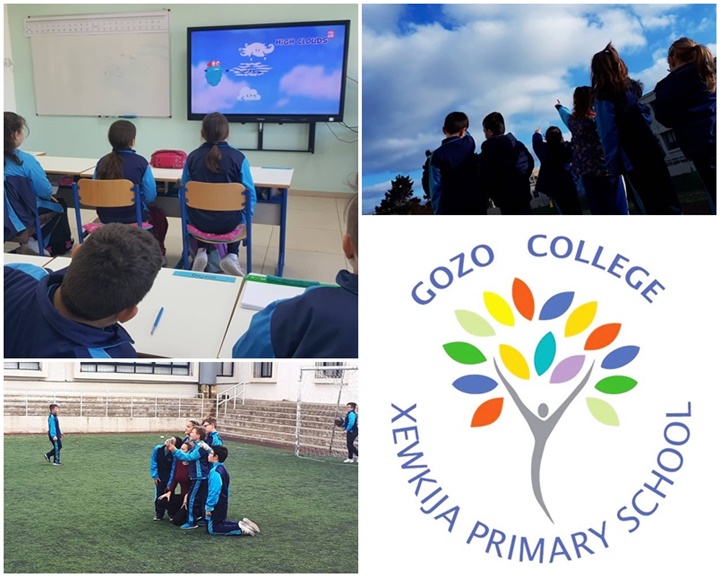 For Grade 3, Farrugia said that the English lesson started with an introductory video about the different type of clouds and a new vocabulary was introduced. Then the teacher read the book ‘Little Cloud’ by Eric Carle.
The students answered a comprehension text and sang a poem about clouds. They were given a ‘Cloud book’ and they had to fill in the required information about how clouds are described according to height from ground level.
In Grade 4, the students were given a detailed explanation of the water cycle, through the storybook ‘The Drop Goes Plop.” Farrugia explained that, “they learned how clouds are important in producing rain.”
Grade 5 students were responsible for uploading cloud observation on a daily basis using the GLOBE Observer App.”
And in Grade 6, during an English lesson, the students saw a video about the types of clouds. As a follow-up, they had a comprehension about clouds. “Together with their teacher, they prepared a chart about the different types of clouds and what the clouds name actually mean.” Farrugia said.
She went on to explain that to reach the community, information about clouds was put up on the school noticeboard for parents and guardians to read. Moreover, all activities were shared on the school Facebook page to reach out to the wider community.
Mercieca and Farrugia said this whole-school effort was important because it provided a unique learning experience for all students and teachers. Farrugia added, “the students were exposed to different learning methods and started to observe the natural environment.”
They concluded by saying that “this effort is a perfect example of how GLOBE can be integrated in all subjects with students of all ages. It can be used as a Case Study to promote The GLOBE Program in schools. It was a huge success and received positive feedback from all those involved.”