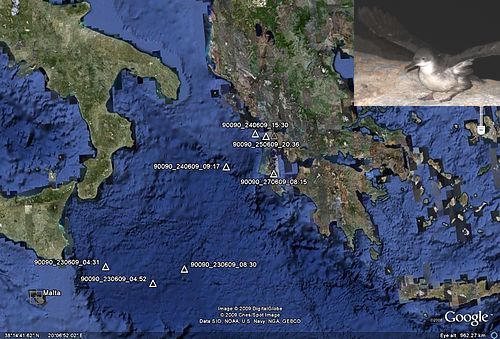
 The EU Life Yelkouan Shearwater project has revealed satellite tracks showing that the first of this year’s Maltese Yelkouan chicks are leaving Maltese waters and are now just a short distance off the coast of Greece and Crete.
In June, six chicks from the Rdum tal-Madonna colony were fitted with satellite tags. These state-of-the-art tags weigh no more than a few grams and have been transmitting regularly over the past few days since the chicks left the colony and embarked on their first flights. The tracks show that several of the birds have already left Maltese waters and are heading west through the Mediterranean Sea. One bird has spent several days in shallow waters off the coast of Greece near the island of Kefallonia, while another is now just south of Crete. A third bird appears to be moving towards the coast of Albania, and on into the Adriatic Sea.
The tags have been specifically modified for use on Yelkouan Shearwaters, and this project is the first time worldwide that chicks of these seabirds have been studied using these techniques. Over the coming weeks the tags will continue to provide data which will reveal how the chicks spend the first few weeks of their lives at sea.
“Not only is this groundbreaking research that is critical for protecting Malta’s internationally important seabird populations, but it is also putting Malta firmly on the map for sea bird research worldwide,” said Dr Andre Raine, BirdLife Malta Conservation Manager. “This technology provides us with the information we need to understand what these birds do once they leave their nests, and with this information we will be better equipped to identify which areas at sea are important to protect them.”
Malta holds an estimated 10% of the world breeding population of Yelkouan Shearwater. The satellite-tagged chicks hatched at the Rdum tal-Madonna colony, which is the largest colony in Malta with approximately 500 pairs. Studying and protecting this colony is the focus of the EU Life Yelkouan Shearwater Project. Ultimately the information collected on the migration and movement patterns of the adult and juvenile birds will be used to designate Marine Special Protection Areas at sea in Maltese waters. It will also provide data to other European countries on where Yelkouans are fishing and wintering so that they can be protected overseas.
The EU LIFE Yelkouan Shearwater project is a partnership of four governmental bodies in Malta and three conservation NGOs, including BirdLife Malta, the beneficiary of the Project. The project is 50% sponsored by the EU Life Unit with additional support from MEPA and HSBC.
This year, the EU LIFE Yelkouan Shearwater project team is again fitting Yelkouan Shearwater chicks with state of the art satellite tags weighing no more than a few grams. The data collected from the tags will be used to help designate Marine Special Protection Areas in Malta and also discover where Yelkouan Shearwaters are fishing and wintering overseas.
Photo shows the satellite locations of a satellite tracked Yelkouan Shearwater chicks from Malta to Greek waters. Three of this year’s tagged chicks, which fledged from the Rdum tal-Madonna colony, have already left Maltese waters and are near the coasts of Greece and Crete. The image is from Google Earth.
The inset image shows a young Yelkouan Shearwater exercising its wings before its first journey away from Rdum tal-Madonna, the photograph was taken by Andre Raine.