 1 comment.
Malta has one of the highest electricity rates in Europe – GRTU
 Email item |  Print item |
|
 Malta is entering 2010 as the country with the highest electricity tariffs in the European Union, this following Government’s announcements last week of once again increasing the utility tariffs. On the 17th of December 2009 Malta placed as the 2nd most expensive for Medium sized industries and medium sized households according to Eurostat. With the introduction of the new tariffs Malta will move to first place.
Contrary to what the Prime Minister had said the new tariffs are substantially greater than the tariffs rashly imposed in October 2008, Vince Farrugia Director General of GRTU said.
The new tariffs are the direct result of 20 years of inefficiencies of Enemalta and Government’s failure to adopt policies and implement structures in this regard. In 2008 GRTU has spoken clearly on the problems our country is facing with the constant increases in utility tariffs, resulting from Enemalta’s inefficiencies. Unfortunately Enemalta can afford to get away with it as the only energy provider in the country. GRTU had also sent a set of concrete proposals to the authorities in order to mitigate the strain of the end user.
· Power conservation programme
· Consumer behaviour change incentivised by Government
· Two billing system inclusive of guaranteed price option and a multi tier option
· Solar public street lighting
· An energy audit protocol
GRTU is very disappointed with the Malta Resources Authority (MRA) who failed to once again consult any stakeholder following our clear request and also as outlined by the European Electricity Directive. The MRA even also failed to hold firm to the methodology. GRTU expresses also lack of confidence in Enemalta’s fuel procurement advisory board which is responsible for fuel purchases. Vince Farrugia Director General of GRTU requested a justification for the actions of these two bodies as otherwise they should simply resign en bloc.
Increases proposed as of January 2010 for the commercial sector (36,874 out of 41,855 Accounts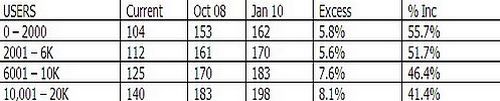 GRTU requests that MCESD be given the facility to investigate the complete findings of the MRA to ensure MRA has fulfilled its regulatory role and is not simply rubber stamping. GRTU also requested MCESD be represented on the fuel procurement advisory committee. Should MCESD find that increases will account for more than 20% a bank guarantee support fund should be established with immediate effect to support SMEs for payment of the tariffs.
Malta’s 41,855 non-residential electricity users will have to fork out an additional €36.4M as a result of the new rates. For non-residential users consuming up to 20,000kWh- 36,874 accounts in all- the average increase will be 48.7% over the current rates.
GRTU is not an organisation that participates in political crusades, however when the system of consultation collapses in a way that Government has permitted prior to the introduction of these tariffs, representative bodies will be forced to take action beyond the realm of social dialogue. GRTU objects most strongly to the way these tariffs have been imposed and is insisting on Government to accept a number of remedial proposals being presented on behalf of SMEs. These proposals do not include any form of setting mechanism. The basis of GRTU’s proposals is a financial support package that will ease the economic impact as these tariffs.
· Bank guarantee support scheme
· Fund to support moratoria on payments to the public sector, including the electricity tariffs
Vince Farrugia warned that the new tariffs will force many businesses to raise prices, lay off workers or even shut down. The impact will also be felt on consumer spending.








Why is the GRTU proposing everything but what will actually work? Enemalta has been offering an inefficient power system, poor customer service and high tarriffs because they have no one to compete against. The government is protecting a monopoly and we are all, quite literally, paying the price. The GRTU should:
-immediately remove Enemalta’s monopoly and open the Malta market to competition
-encourage Eni to connect Malta to the Italian grid via underwater cables from Sicily
-issue licenses for wind and wave-technology based operators
-subsidise mass adoption of solar energy and begin punishing those who don’t adopt the technology through higher energy prices. Any excess electricity produced through solar energy should be fed back into the grid and discounted from the user’s energy bills
There are plenty of examples from around the world where sound energy policies are making a difference. Malta is blessed with 300 days, surrounded by wind and waves and fails to make use of all thos clean energy which surrounds it.
What is being proposed by the GRTU is a red herring, designed to keep protecting an inefficient government monopoly who should be forced to compete or die.
People, wake up!