Be the first to comment!
PA and Superintendence – Sacrificing heritage in Xaghra for construction – FAA
 Email item Email item
|  Print item Print item
|
|
Flimkien ghal Ambjent Ahjar (FAA) said that it making a final plea for “good sense to prevail,” and for the Authorities to “value our prehistoric heritage above a few housing units to be green-lighted in the Ta’ Verna Temple area of Xaghra, Gozo, on Tuesday, with the approval of the Superintendence of Cultural Heritage.”
FAA stated that “the Superintendence of Cultural Heritage is not taking action to protect Malta’s prehistoric heritage in the Sta Verna temple area, as it is legally obliged to do by the Cultural Heritage Act”
FAA noted that the Act reads: “The mission of the Superintendence is to fulfil the duties of the State to ensure the protection and accessibility of cultural heritage as defined in this Act… to advise and coordinate with the Planning Authority action in safeguarding cultural heritage when considering applications for planning permission relating to development affecting objects, sites, buildings or landscapes which form part of the cultural heritage”
FAA pointed out that “ignoring FAA and residents’ calls for the Superintendence to issue an Emergency Conservation Order, it has instead approved PA 03678/23 to be granted on Tuesday, to build seven terraced houses on a site where a prehistoric pit was found containing skulls arranged in ritual burial pattern that has never been recorded before.”
It went on to say that initially, no mention of the pit containing human bones was recorded in the archaeological monitor’s Cultural Heritage Surveillance Data Sheet re the works to remove soil on site.
“Spotting human bones on the site, a Xaghra resident drew the attention of FAA, which reported the matter to the SCH,” said FAA. Subsequently, it said a full report of the find was submitted by the monitoring archaeologist, (reproduced below), “however the SCH is now claiming that works can go ahead, alternating its versions,” saying “significant archaeological remains have been recorded in the vicinity, not located within the site” with “only a single small burial pit has been identified [on the site], which was investigated”
FAA has condemned SCH’s dismissal of the site’s importance in the light of the statement by Caroline Malone, a British archaeologist, Emeritus Professor Queen’s University Belfast specialised in Mediterranean Prehistory who has worked on the Ta’ Verna site: “Santa Verna extends to many scores of meters beyond the extant megaliths and scientific excavation reveals superficial remains over probably 3-5 hectares where our survey found significant prehistory. Beneath the surface there are deeply preserved ancient soils to depths of almost a meter, containing all forms of archaeological preservation-bones, seeds, pottery, structures, lithics and environmental materials that have the potential to truly reveal Malta’s unique prehistory. There are almost no comparable landscapes remaining anywhere in Malta, something Ministers and the SCH should understand.”
FAA argued that “the SCH declared that no remains were found on site, when its own monitoring archaeologist (after FAA reported the bones) confirmed that bones were scattered in the entrance and at the edge of the site.”
Moreover, FAA said that the Planning Authority case report states, “The proposed development is counter to DC15 P26 which requires that new residential development shall not be less than 6m wide.” FAA pointed out that “in spite of breaking a fundamental planning regulation to ensure housing standards, the Planning Authority is recommending approval of this row of cramped 7 houses on a site approved for 4 houses.”
FAA concluded by saying that, “the Authorities’ determination to promote development even at the cost of Malta’s priceless heritage, is glaringly obvious in the reply of SCH high ranking representatives who, when taken on site, verbally declared that economic potential is not going to be sacrificed for a few bones.”
Snippet from FAA of the archaeological monitor’s report:
The surface record of the Cambridge Gozo Survey By Caroline Malone, Reuben Grima, Rowan McLaughlin, Eoin W. Parkinson, Simon Stoddart & Nicholas Vella highlighted the need to sample early Neolithic stratigraphic deposits in order to extract materials for dating, cultural identification, palaeo-economic reconstruction, and to obtain a range of environmental indicators from this little-known period.
Quote: “The new excavations at ?gantija and Santa Verna add significantly to the results from previous work at the Xag?ra Brochtorff Circle, confirming the status of the Xag?ra Plateau as one of the most important localities for surviving prehistoric archaeology in the Mediterranean. Here, we might mention the ‘cave’ sites on the peripheries of Santa Verna and ?gantija, the threatened earlier Neolithic sites (e.g. Is-Sru?) and the date and function of the other burial monuments and megalithic structures noted in the locality during previous surveys (Evans 1971).
The Cambridge Gozo Survey revealed several ‘hotspots’ of prehistoric activity, particularly at Ta’ Kuljat, Santa Verna and the environs of ?gantija. The area surrounding Santa Verna was very rich in cultural material from all prehistoric periods, making Santa Verna a key site for providing a continuous and well-preserved sequence spanning the Neolithic and Temple Period.
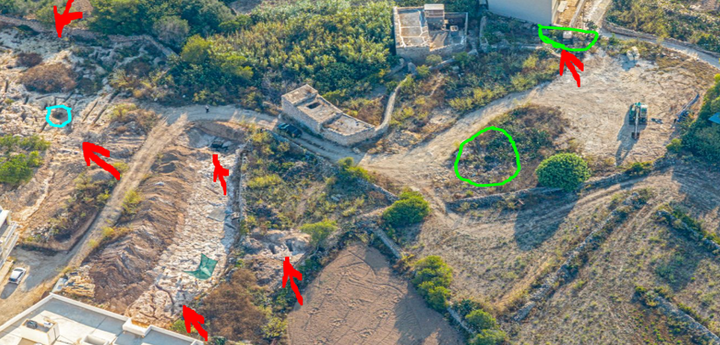
Photo FA: Sta Verna archaeological potential