Be the first to comment!
Din l-Art Helwa Ghawdex sets out its plans for Qbajjar Battery

 Email item |  Print item |
|
Din l-Art Helwa Ghawdex, in a statement on Wednesday, referred to reports in the media about the roof collapse of the Qolla l-Bajda Battery in Marsalforn, Zebbug, Gozo.
Din l-Art Helwa Ghawdex said that it would like to clarify what has happened and what it is planning for the abandoned fortification once it signs the guardianship deed with the Superintendence of Cultural Heritage.
The organisation said that on Saturday, the 21st of March, a team from Din l-Art Helwa and Din l-Art Helwa Ghawdex made a thorough survey of the interior and exterior areas of the Battery.
”Comparing the present state of the Battery with photographs of the site taken in the 1960s, before it was converted into a discotheque (and later into a restaurant), it is obvious that the Battery, although a Scheduled Grade 1 building, suffered great damage due to the illegal alterations carried out,”’the organisation said. It highlighted that the enforcement case from 1999 ‘only’ 27 years ago stated:
“Enforcement Case EC/00068/99 (which remains active to the present), of the site at It-Torri tal-Qbajjar, Marsalforn, Qbajjar, Zebbug, Gozo. It is classified as a No Permission Sought case and falls under the category of a listed building. The alleged infringement consists of unauthorised development within a scheduled property, including an extension at upper-floor level, construction in concrete blocks, the pointing or rendering of walls, and the removal of paving at ground-floor level. In summary, the case relates to construction works carried out without a permit. The interested party named in the case is Mr George Said, identified as the contravener and the prime contact.”
DLHGh said that its team found that ”most of the entire original interior of Qolla l-Bajda Battery had been destroyed and replaced with modern fabric, largely consisting of reinforced and pre-stressed concrete slabs and beams. The original stone ceilings of the two blockhouses, probably formed with stone arches, had been removed and replaced with concrete beams. More than half the area of the gun platform had been destroyed and a new platform, later supplemented with stone arches, was constructed approximately one metre higher than the original level. A large area was excavated beneath this new platform, most likely destroying a water reservoir in the process.”’
It added that ”the original entrance doorway was replaced by a wider opening set considerably higher than its original position. The west blockhouse was also subdivided into several rooms and toilets. The gun emplacements on the platform were likewise altered: two were blocked up and turned into windows beneath the new concrete platform, while the others were reduced in height.”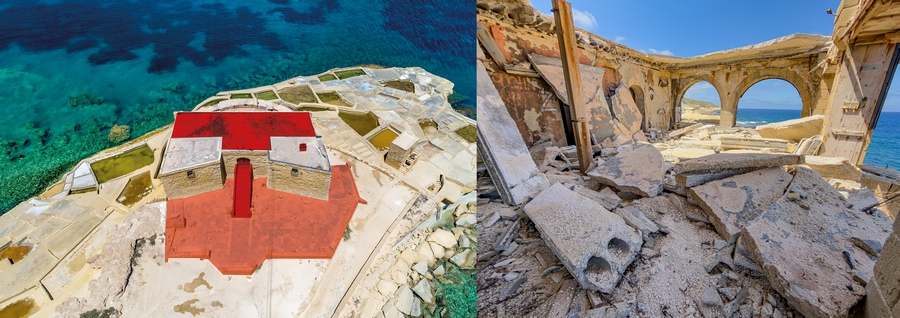 Din l-Art Helwa Ghawdex said that, together with the experts commissioned by Din l-Art Helwa, it is ”resolved to remove all the illegal accretions and to restore Qolla l-Bajda Battery, as far as possible, to its original state as built by the Knights of St John.”
The organisation explained that ”the only interior spaces will therefore comprise the two blockhouses, complemented by the fine open expanse of the gun platform, restored to its original level. The entrance doorway will be returned to its original position on the façade, so that it once again opens directly onto the gun platform at its original level.”
DLHGh confirms that the recent roof collapse must have happened between Good Friday and Saturday, the 4th of April. ”We were informed that Friday visitors who went inside the building did not notice any collapse. Whilst other visitors on Saturday afternoon did. Photos were sent to DLHGh on Saturday night and upon confirming the collapse and what part had collapsed on Easter Sunday morning the police were informed. Soon after the area was cordoned off.”
The organisation stated that ”it is very important to point out that the collapsed roof was not part of the original structure of the Knights. It was the west side of the concrete platform built illegally by the lessee and would have eventually been removed when the works on the restoration and rehabilitation of the battery would have started.”
From the on-site visit by DLHGh said that ”it is obvious that the collapsed ceiling was constructed with prestressed concrete slabs. When the internal stressed steel cables tear, in this case probably due to corrosion, the failure of the slabs is sudden and explosive. The tensioned steel inside the concrete is released like one would release a tensioned spring.”
It said that ”fortunately nobody was hurt. The site is in a precarious and dangerous situation and should not visited. Even the beautiful salt pans immediately under the Battery should be avoided.”
Din l-Art Helwa and Din l-Art Helwa Ghawdex said that they are ”busy working on the documents requested by the Superintendence for Cultural Heritage (SCH) so that the guardianship deed can be signed by Din l-Art Helwa Ghawdex and Din l-Art Helwa.”
”This collapse has necessitated a revision of the documents that were nearing completion. A photographic survey has already been carried out and the method statement and future use plan will be sent to the SCH as soon as possible,” it said.
Din l-Art Helwa stressed that it is ”fully aware that the restoration will be neither straightforward nor inexpensive. Thankfully several sponsors have already come forward to assist.”
As with previously restored projects entrusted to its care, the eNGO said it is ”confident that the same will be achieved at Qolla l-Bajda Battery. It will serve as an important case study of how a Grade 1 scheduled building, decimated by unscrupulous commercial exploitation and then left in ruins, in breach of the former tenants’ duty of care, can be restored to its original splendour for all to appreciate and enjoy.”
Photos: Din l-Art Helwa – Aerial photo April 06, 2026; Qbajjar Battery 1960s; and
Qbajjar Battery with illegal extensions in red DJI with photo taken inside April 06, 2026