Be the first to comment!
Conference on the Gozitan Identity and how the Church in Gozo needs to adapt
 Email item |  Print item |
|
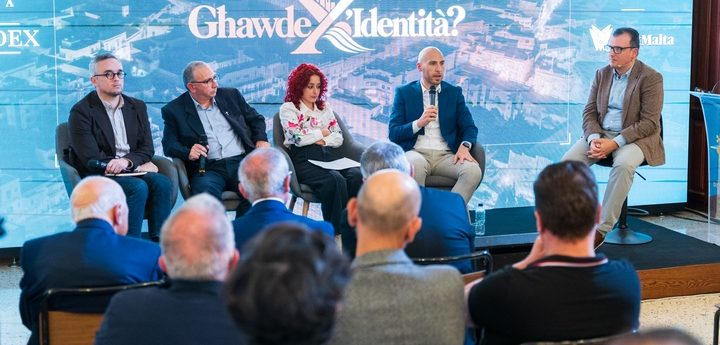
Fondazzjoni Il-Hajja f’Ghawdex has organised its third conference, under the theme “GhawdeX’Identita?” The conference explored how Gozitan identity is evolving and how the Church in Gozo needs to adapt its pastoral approach to these emerging realities.
In his opening reflection, the Foundation’s President, Joe W. Psaila, noted how the very words ‘Ghawdxi or ‘Ghawdxija’ already convey a sense of belonging and place. Professor George Cremona, who moderated the conference, described identity as a “collage” of different perspectives which, as a Church, we need to be understand and analyse.
The first two interventions explored how Gozitan identity is changing from a social perspective. Psychologist Dr Nicholas Briffa highlighted a number of aspects, including how the lives of Gozitans continue to be shaped around ferry schedules and how resilience has always been a defining feature of the Gozitan character.
He also noted that Gozo still retains a reality in which the parish works closely with local governance, particularly the local council, something he identified as a positive characteristic.
He observed that the small scale of Gozo can itself be an advantage, since in such a context being known can also mean being understood. Change, however, has also reached Gozo, and when a place changes, people may experience a sense of loss. ”Identity is itself constantly evolving and, therefore, when someone chooses to live in Gozo and wishes to identify as Gozitan, this can offer an opportunity for enrichment,” he said.
Dr Briffa identified three needs which are essential to a healthy community: providing people with the opportunity to belong, allowing freedom of choice, and giving individuals the opportunity to learn and build a future.
Elena Cardona remarked that she feels Gozitan identity remains very strong. Identity, by its nature, cannot simply be identical to that of someone else. In this context, people who have moved to Gozo are increasingly coming to regard the island as their home. She therefore argued that we should not fear some of the changes taking place around us. Interaction with others can enrich who we are, without necessarily taking away from our own identity.
The pastoral response to these new realities was addressed by Rev. Professor Carl-Mario Sultana and Dr Stanley J. Portelli. Prof. Sultana noted that Gozitan society is no longer as homogeneous as it once was. This means that what worked “yesterday” does not necessarily work “today”.
He stressed that, as a Church, we should not be afraid of those who come from outside our communities but rather be capable of reading the signs of the times.
He identified language and communication as one of the Church’s greatest challenges today: how can the Church remain relevant in a world in which everyone is competing to communicate their own message? He also emphasised the importance of ensuring that everyone feels that they are an active participant in the Church and can contribute to its pastoral direction.
In an ever-changing society, he argued, there is a need to create small spaces for sharing and dialogue, enabling people who come from outside Gozo to become integrated within our communities. Within this context, ongoing formation must remain a priority so that the Church itself can respond to a society that is continuously changing.
Dr Stanley J. Portelli emphasised that, as Gozitans, it is important to come together in pursuit of the common good. We must be able to speak about those issues which are important to us, including the natural environment.
Speaking from his experience as an active layperson, he said that the Church in Gozo is aware of the challenges facing society and benefits from the commitment of many laypeople who are present in the more difficult and often less visible areas of society, working particularly with the most vulnerable.
He also noted that, while insularity remains an important part of the Gozitan experience, we should not forget that Gozitans today are connected to the wider world. This brings with it several challenges, including those associated with social media and the use of digital tools.
Dr Portelli stressed that Gozitans still need personal contact from the Church. Some of the most important moments within the Church are those in which genuine human contact takes place, particularly in a world that is already filled with noise. Within a context of continuous change, he added, it is equally important for the Church to recognise its own limitations and avoid unnecessary competition that can distract it from its true mission.
The Bishop of Gozo, Anton Teuma, brought the conference to a close by reflecting on the different circles which contribute to a person’s identity. He noted that, as Gozitans, our identity is shaped by various factors, including our history, our geography and the realities we are living today.
He observed that, within a small community such as Gozo, the way people relate to one another assumes particular importance. He also reminded those present that, as a Church, we must never lose sight of the fact that our pastoral mission must be centred on the person of Jesus. Within this context, ongoing formation remains crucial.
Throughout the conference, several short video clips were also screened. These featured Gozitans living both in Gozo and away from the island, as well as people from other countries who have made Gozo their home and who reflected on their own sense of belonging to the island.
In another video feature, Fr Joseph Hili provided a brief analysis of the survey carried out during the previous summer on “Faith, Religious Practice and Attitudes in Gozo”.
The Fondazzjoni Il-Hajja f’Ghawdex was established by the Diocese of Gozo in 2020 with the primary aim of safeguarding the publication Il-Hajja f’Ghawdex, a monthly magazine covering all matters related to the island of Gozo.
It also has the primary aim of promoting aspects related to Christian identity and culture, especially in the local milieu. The Foundation also manages the communication activities of the Diocese of Gozo.
Over the past two years, the Foundation has organised two conferences: one on Pope Benedict XVI and Christian hope, and the other on Bishop Nikol G. Cauchi as a promoter of the Second Vatican Council.
Photo: Fondazzjoni Il-Hajja f’Ghawdex/Anthony Grech