Be the first to comment!
Ill-equipped police unable to control illegalities – Birdlife
 Email item Email item
|  Print item Print item
|
|
Birdlife has announced that the police were unable to respond to almost half the reports filed by only two of their BirdLife Malta surveillance teams over the last weeks, showing an ill-equipped force failing in spite of the best intentions.
As BirdLife announced the launch of the Spring Watch camp, the organisation said it had already put two teams in the field in the preceding two weeks. They came across illegal trapping sites on almost every occasion, in spite of covering only a limited area in Malta.
They said that the teams, in just over two weeks, came across 78 illegal active finch trapping sites and filed 32 reports to the police, where single reports covered multiple illegalities in the same area. Each team spent most of the time in the field waiting for the police to arrive. Too often, they did not come.
“In over 67 per cent of the cases it took over an hour for the police to arrive, which meant most of the trappers had ample time to get away. Trappers were caught on only five occasions.”
 “In many instances, the only available ALE vehicle was far from the location of the crime – the longest response time was 2 hours and 37 minutes. Police officers from local stations turned up on only three occasions, showing district police were not sufficient reinforcement to back up the ALE.”
Dr. Andre Raine, BirdLife Malta Conservation Manager, said, “As finch migration peaked, our surveillance teams constantly encountered illegal finch trappers. The ALE is unable to respond to the majority of reports because there is often only one vehicle available. When they do manage to come, it is often too late.”
“Even when the police did manage to turn up, trapping ‘equipment’ such as decoy birds and nets were often not even confiscated. The police have no place to keep the birds prior to the case going to court.”
“But when the tools are not taken away, the trapper is free to return and repeat the offence. In fact, on several occasions the reports involved sites previously reported to the police.”
The conservation organisation have been harshly critical of the government for failing to invest in reinforcing law enforcement capabilities while announcing the opening of a spring hunting season.
“Law enforcement cannot be effective when the ALE unit, at full strength, consists of less than 25 officers. The government’s comical plan to control the number of birds shot depends on each hunter sending a text message every time a bird is killed and ‘spot checks’ by the ALE.”
BirdLife Malta said that their teams have also witnessed several illegal hunting incidences and continues to receive shot protected species, the latest one being a Marsh Harrier last Friday.
“The lack of resources plaguing the ALE shows a clear lack of commitment by the government to enforce hunting and trapping legislation. Currently, there is little control in the countryside,” Dr Raine added.
46 volunteers from 8 countries are in Malta for the organisation’s Spring Watch camp where teams will record illegalities in the countryside. The camp will last three weeks and, for the first time, it will be a joint operation with the Germany-based group CABS (Campaign Against Bird Slaughter). The resulting evidence and analysis will be shared with government and the European Commission.
The footage taken by the two BirdLife surveillance teams over the last two weeks was given to the ALE to help with their investigations. Aerial surveillance also revealed many active trapping sites. Analysis of the data gathered is ongoing and a report will be finalised following the migration season.
Notes: Trapping is not permitted throughout the EU under the Birds Directive. When Malta joined the EU it negotiated a five year phasing out period for the trapping of seven finch species. Annex XI to the Act of Accession for Malta gives the conditions agreed upon granting Malta a 5 year phasing out period.
The agreement states: “By way of derogation from Articles 5(a), 5(e), 8(1) and Annex IV(a) of Directive 79/409/EEC, Carduelis cannabina, Carduelis serinus, Carduelis chloris, Carduelis carduelis, Carduelis spinus, Fringilla coelebs and Coccothraustes coccothraustes may be deliberately captured until 31 December 2008 by traditional nets known as clap-nets within the Maltese islands exclusively for the purpose of keeping them in captivity in accordance…”
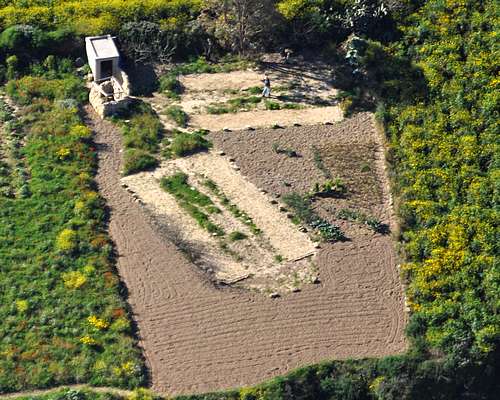
Photos – An aerial photo of a very large active trapping complex in Xaghra, Gozo. Photo by Giulia Valentini.
An active trapper was photographed from the air during aerial surveillance carried out by BirdLife Malta. Photo by Giulia Valentini.