Be the first to comment!
Malta’s total dependence on fossil fuel imports driven by continuously increasing demand
 Email item Email item
|  Print item Print item
|
|
Energy consumption in Malta is derived from a range of imported fossil fuels which are burnt for different uses.The three major energy consumers are domestic transport, industry and power stations.
Transport includes all types of vehicles, sea craft and airplanes. All these moving units mainly consume leaded petrol, unleaded petrol and diesel fuels. Their consumption varies according to the type of unit and how much it is used. This reflects in a continuous change the demand of fuels according to the travelling habits on the islands.
Energy statistical data for the Maltese Islands show that there is a continuous increasing demand for fossil fuel energy during the past eight years. Such an increase during this period was of 17 per cent. Malta is totally dependent on fossil fuel imports and its fuel mix is becoming cleaner following measures such as the abolition of leaded petrol use in 2003 and the supply of low sulphur diesel.
The data indicates that fuel oil is the most imported commodity since it is used for the daily operations of the two installed power stations on the Island. The second most consumed fuel is the low sulphur diesel. This is followed by the unleaded fuel since this type of fuel is also used by the transport sector.
It is evident that around 60 per cent of fuels (fuel oils) is used for electricity production while another 34 per cent of the total fuel share (Diesel, Gas oil, Unleaded, Jet fuel) is consumed by the public and private transportation.
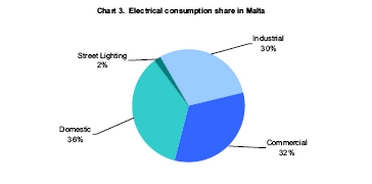
Between the year 2000 and 2006 Malta’s gross energy consumption increased by 19 per cent with the domestic sector absorbing around 36 per cent of total electrical consumption. The commercial and industrial sectors are the next, with the commercial sector absorbing 32 per cent and the industrial sector 30 per cent. Such a distribution is mainly attributed to the accelerating energy demand from economic growth.