Be the first to comment!
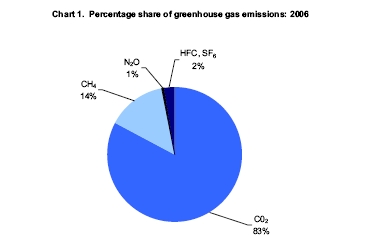
Carbon Dioxide accounted for 83 per cent of all greenhouse gas emissions in Malta during 2006
 Email item Email item
|  Print item Print item
|
|
World Environment Day is commemorated each year on 5 June, with this year’s theme being “Towards a Low Carbon Economy”. To mark this occasion, the National Statistics Office has issued a set of statistics which relate to greenhouse emissions in Malta.
The data presented gives a general overview of greenhouse gas emissions in Malta over a 16-year time span. Greenhouse gases comprise Carbon Dioxide (CO2), Methane Gas (CH4), Nitrous Oxides (N20), Hydro Fluoro Carbon (HFC) and Sulfur hexafluoride (SF6).
The data shows that there is an increasing trend in the emissions of all greenhouse gases, with some fluctuations in particular instances. Overall, throughout this time span, emissions increased by 45 per cent. When the percentage shares of emissions for 2006 are analysed, it is evident that Carbon Dioxide is the highest greenhouse gas emittant, accounting for 83 per cent of total emissions in Malta in 2006. This is graphically presented in Chart 1 above.
Chart 2 below shows trends in the intensity of greenhouse gas emissions per capita. It can be observed that overall emissions per capita have risen from around 5.78 tonnes in 1990 to 7.58 tonnes in 2006.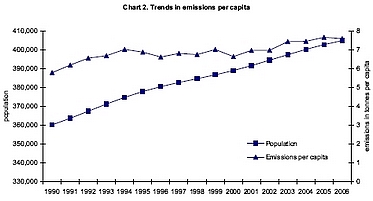
Emission trends by sector are presented in Chart 3 below. It is clear from the data that the lion’s share of emissions emanates from the energy industries. A far second is road transport, with 19 per cent of total emissions in 2006. A closer look at the data demonstrates that emissions from energy-related industries have increased by 46 per cent in 2006 when compared to 1990, while those from road transport have risen by 51 per cent.
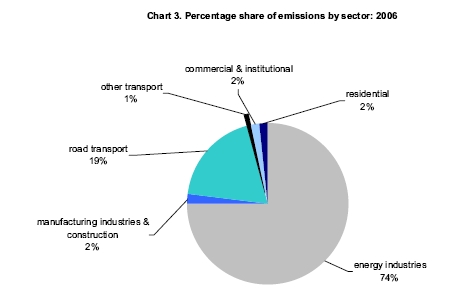
These were contrasted by decreasing trends in the manufacturing, commercial/industrial, and residential sectors.