Be the first to comment!
New scholarships scheme launched with increased budget
 Email item |  Print item |
|
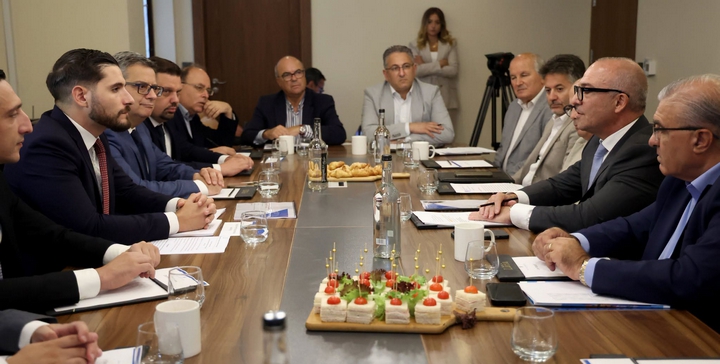
The Ministry for Education and Employment is launching a new scholarship scheme using funds from the European Social Fund 2007 – 2013 – Empowering People for More Jobs and a Better Quality of Life.
Minister for Education and Employment Evarist Bartolo said that scholarships entrance requirements are being widened to allow more space for individuals to apply for Masters programmes. The Minister stressed the importance of such scholarships in order for people to be equipped with the necessary tools that a modern economy requires.
Dr Ian Borg, Parliamentary Secretary for EU funds and EU Presidency 2017, said that funds would have been lost unless they were used by the end of the year. In this regard, he complimented the Ministry for Education and Employment for its hard work to maximise the potential through the use of European Union funds.
He reiterated that education and training are being given a priority by the EU. Moreover, funding for such schemes are being expanded in order to reach a wider base.
This new scholarship scheme is called ‘Master It’ and will empower the labour market to increase their level of skills and provide more high-skilled jobs for employers.
The budget allocation for Masters Scholarships has been increased to a minimum of €2 million, which is at least €700,000 more than the previous year.
Nine key sectors were identified within our economy and opportunities to improve the skill-set of workers and students in these areas will not only provide the foundation for a better career for the people but also provide an improved skill-set for the businesses and the economy.
High-End Manufacturing
Examples of specialisation: Renewable Technologies, Product/Equipment Design, Plastics/Advanced Materials Manufacturing.
Life Sciences
Examples of specialisation: Dietetics, Health Psychology, Leadership and organisational development in the health sector, Clinical Sciences, Pharma manufacturing, Veterinary
Educational Services
Examples of specialisation: Hearing/Visual Impairment, Severe, Profound and Multiple Disabilities, SEBD, Autism, Learning Disabilities, Multi-Sensory Impairments, Inclusion Coordination, Career Guidance, Educational Psychology, Clinical Psychology, Counselling, School Curriculum Development, Family Therapy, Literacy, Education Planning, Vocational Education, Humanitarian Action.
Financial Services
Examples of specialisation: Funds Management, Back office support Management, Financial Mathematics, Marketing, Innovation, Strategy, Economics, Business Analytics, E Commerce.
Transportation & Advanced Logistics
Examples of specialisation: Ship Management, Ship Registration, Yachting/Super Yachting, Aircraft Maintenance/Repair
Higher Quality Tourism
Examples of specialisation: Eco-Tourism, Health Tourism, Sports Tourism.
Creative Industries
Examples of specialisation: Digital Media, Online Gaming, radio/television/film production, scriptwriting, visual effects.
Environment
Examples of specialisation: Alternative Energy, Waste Management, Climate Change, Green Technology, Crop production, Marine Management
ICT
Examples of specialisation: Software development in specific areas (such as security, telecommunications, health, marine), Microelectronics, Telecommunications and Satellite, ICT for students with Special Educational Needs, Forensic Computing.
Individuals not already in possession of a Masters or a Doctoral degree can apply. Courses have to start between tomorrow 1 May, 2013 and end of this year, that is 31 December, 2013.
Dr Ian Borg went on to say, “we have removed certain criteria of ineligibility. We are no longer making a distinction between an Honours or a General Degree. Even a person who is not in possession of an undergraduate degree may apply, provided that a recognised University is accepting the applicant to register for a course.
“We believe that some Universities give credit to work experiences, informal and non-formal learning and are ready to accept such mature students. We do not wish to hinder these people from pursuing their studies and achieve a Masters degree should the recognised University be satisfied with its entrance criteria.”
The Parliamentary Secretary continued, “for those who wish to study on a full-time basis, the maximum amount that can be awarded is €8,000 per annum. This amount includes a maintenance grant of a maximum of €2,500 per annum.
“Full-time students benefit from other allowances, such as if they are studying abroad (€2,500 per annum) or Gozitan students studying at the University of Malta (€1,050 per annum).
“We believe that we should assist parents and guardians who wish to pursue studies at Masters level. Therefore we are offering allowances for such scholarship awardees with children (€1,170 per annum for the first child; €700 per annum for any additional child under the age of 15).
“For those who wish to take studies at distance learning or part-time, the maximum amount to be awarded is €3,000 per annum.”
“The Ministry for Education and Employment will be appointing a Selection Board to evaluate the applications and award the scholarships. The Ministry is appointing an Appeals Board as well in case an applicant would like to contest any decision of the Selection Board or any administrative decision of the Directorate for Lifelong Learning, which shall be responsible for this scheme,” the Parliamentary Secretary concluded.
The Conditions that govern this scheme will be published next week on the website www.myscholarship.gov.mt. The closing date is 14 June, 2013.
Final year students at the University of Malta will have an Information Meeting on the 8th of May, 2013, on the University Campus, Gateway Building Hall E between noon and 2.00pm. An Information Meeting is planned to take place in Gozo on the 31st of May, 2013 at 5.30pm.
Additional Information
Scholarships awarded by schemes administered by the Directorate for Lifelong Learning: