Be the first to comment!
European Elections: Gozo’s vulnerability as an island region
 Email item |  Print item |
|
The European Union recognises the existence of regions whose permanent structural handicaps result in certain shortfalls in development. Three types of permanent structural handicap have been defined, mountainous areas, territories with a low population density and island territories. Gozo’s vulnerability as an island region was explicitly mentioned in a declaration on Malta’s accession to the EU. But what progress has been registered since then?
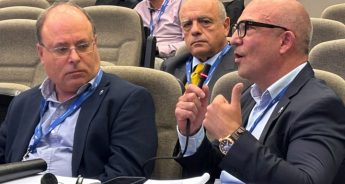
A debate in Gozo with MEP candidates recently explored exactly that question. Moderated by The Gozo University Group’s Ryan Mercieca, a European Parliament Information Office (EPIO) the held in conjunction with the Gozo NGO Association explored this issue in depth to attempt to gauge the types of handicap experienced by Gozo and to hear the recommendations of 5 MEP candidates at the top table on how to treat this island territory going forward in an EU context, with 2 or 3 additional MEP candidates in the audience.
The Gozo NGO’s Association is an umbrella organisation holding about 300 Gozitan NGO’s under its dynamic president Carmel Zammit. Its aim is to promote and give initiatives to local Gozitan organisations.
With standing room only at the back of the crowded confines of Vini e Capricci on the Gozitano Co-Operative Complex, two sticking points in the discussion recurred throughout, firstly that the EU defines an island as having no permanent connection to the mainland, and, secondly that Gozitans feel they need to by-pass the Maltese authorities in order to obtain what they see as just treatment from the European institutions directly.
Introducing the discussion Dr. Peter Agius Head of the European Parliament Office in Malta said that this was the fifth Gozo event held by the European Parliament Office in the last year and that “for the European Parliament Office, Gozo is already a region as it has its own specific issues and needs.” Dr. Agius added that the morning would be devoted to understanding what a region in the EU is all about and asking the question “whether we want Gozo to be given the official status as a region in the EU with all that this entails.”
The Maltese, it would appear from the stakeholder sentiment at the event, “are not acting as a facilitator for the Gozitans to achieve this island region status which will qualify them for special treatment in terms of funding from the EU. It all boils down to jobs, money and social cohesion for Gozo’s ageing resident population, alongside Gozo’s potential, eligibility and desirability of being a region in the EU.”
MEP candidates for the May 2014 European Parliament elections attending the debate included Lino Bianco, Kevin Cutajar, Cyrus Engerer, Stefano Mallia, Carmel Cacopardo, Alfred Sant, Norman Lowell and Roberta Metsola.
It was pointed out that in institutional terms, qualifying territories have started to receive special treatment and clear reference is made to them in the Treaties establishing the Community as well as reference by the Maltese Government to Gozo on accession. Article 154 of the Consolidated Treaty of Maastricht refers to “the need to link island, landlocked and peripheral regions with the central regions of the Community.” In addition, Article 158, introduced by the Treaty of Amsterdam, makes reference to the island regions, singling out the poorest. Finally, Declaration 30 adopted by the Conference which adopted the Treaty of Amsterdam “recognises that island regions suffer from structural handicaps linked to their island status… and (…)specific measures may be taken, where justified, in favour of these regions…”
It was noted that “However important these European institutional references may be, they have so far produced very little for Gozo in terms of specific measures, even though at the same time the Maltese Islands have made good use of pre and post-accession funding.” Vigorous banter between MEP candidates and attending stakeholders “exposed a lack of concrete data on the amount of EU funds allocated by Malta’s central government to Gozo over the last few years, with Gozitans alleging that figures being bandied about did not accurately reflect the reality.”
From the floor both Mr. Joe Woods and former MP Lino Debono contended that insufficient statistical information was neither available nor obtainable without a study programme or fully dedicated research programmes about Gozo and that lack of an NSO outpost on Gozo was compounding this lack of objective evidence about trends, economic information, demographics and GDP shifts in Gozo.
These questions relating to the availability of information resulted in some heated discussion. “Malta must not only consider the economic and social situation of Gozo and make a certain number of recommendations but also collect a large amount of quantitative and qualitative data in support of those considerations.”
Beyond the creation of a base of reliable and timely information on a variety of subjects relating to Gozo which do not necessarily fit within existing administrative boundaries, most of the day’s discussion centred on how Gozo could achieve the status of a region within the EU. This, argued Mr Woods from the floor, “essentially depended upon the Gozitan vision for the next 20 to 30 years and should be based on a well crafted statement of intent by the residents of Gozo. That no vision existed exacerbated negative sentiment, and, quoting the Book of Proverbs, Mr. Woods eruditely warned that, a tribe without a vision will perish.”
MEP candidate Lino Bianco went a step beyond this position, saying that there had been “enough talk on these issues during an October 2013 MEP event held at Il-Hagar in Victoria, and that in the intervening 6 months or so stakeholders could easily have moved their agenda forward in a concrete manner rather than have yet another round of discussions and debates on essentially the same issues.” Professor Bianco went on to say, “Stop talking and move to action. The precedents existed and the departure point was clearly about agreeing that Gozo is, in fact and in every other sense, a region.”
Which led visiting speaker Juan Gual de Torrella Guasp, president of the Mallorca Chamber of Commerce and president of the Network of the Insular Chambers of Commerce and Industry of the European Union, to take up the broader issues in the context of the EU parliamentary elections coming up in May. There is change in the air argued Mr. Guasp, stating that from an entrepreneurial point of view the upcoming election is the most important for Europe to date. His network has been lobbying for 14 years to ensure that technocrats and politicians in Brussels “Think Islands!” and he also maintained that although many Europeans may be disappointed with the EU and perceive it as bad for daily life, “It’s the lesser of two evils.” Mr. Guasp encouraged Gozitans to ensure that their lobby is well organised and clear in its objectives, and to collaborate widely to ensure advocacy for local issues and needs.
Prospective Gozitan MEP candidate Kevin Cutajar intervened saying that Gozo has “very little chance of having a representative in the European Parliament.” Mr. Guasp said that electoral policy discussions had to be held with the European institutions and that even Spain suffered from the fact that party political criteria dominate candidate selection rather than regional considerations.
He said, “the Balearic Islands have a higher GDP than other Spanish regions, today Balearic GDP per capita is on par with the. EU average and well above the Spanish national average.” The tourism boom has caused a deep transformation of the region which comprises three main islands, namely Mallorca, Menorca and Ibiza, and the two tiny and unspoilt islands of Formentera and Cabrera. He outlined how the islands have transformed from a rural area into one of Spain’s richest regions through attracting Foreign Direct Investment to support 13 million tourists annually that contributes 85% of the GDP of the Islands.”
He concluded with advice to the Gozitan stakeholders and prospective MEP’s, “To become a region start alongside the main island of Malta. Consolidate your position now as a region going forward. Islands are special and different, Gozo is a diamond and has a lot of potential for growth, but not necessarily for development. Bridges and tunnels will result in a loss of identity and will impede your status as an island for EU regional policy.”
Dr. Sant argued that the Gozitan situation is very clear, the island has fallen back vis a vis Malta and other island regions across the EU. This decline has to be addressed on 3 levels, political, institutional and then on a planning & implementation level by agreeing on the necessary regional structures. Gozo, Dr Sant said, is a “micro micro region” which had its agriculture sector in decline, its artisan sector in decline and its tourism sector “barely just afloat.” National regulations do not fit the Gozitan context maintained Dr. Sant and he strongly advocated a holistic plan to “change the scenario from Gozo, not Valletta”.
Stefano Mallia said he supported the idea of one MEP seat reserved for Gozo, saying “I say this in view of Gozo’s particular economic and social dimension that needs to be acknowledged and catered for.” Mallia said that “if one seat is specifically allocated to Gozo, the country would be sending a powerful political message to the people of Gozo as well as to Europe itself.”
“Gozo is a region in its own right that has circumstances that need to be addressed specifically with specific actions,” he said. He said a vision for Gozo must be developed to give the sister island’s a clear specific direction for the next five years. “This is especially important for the young people of Gozo who today don’t know in which direction the island is going,” Mallia said.
Cyrus Engerer maintained that Gozo had been declining because Malta uses a “one size fits all” approach, and stood squarely behind the implementation of a regional office for Gozo in Brussels, part of the PL’s electoral pledge. Taking this train of thought further, Engerer stated that the Regi Committee within the European Parliament is vital for Gozo, explaining that this committee, The Regional Development Committee, is responsible for the EU’s regional and cohesion policy. It assesses the impact of other Union policies on economic and social cohesion and coordinates the Union’s structural instruments.
Mr. Engerer questioned why no Maltese MEP was sitting on this important committee. In addition, he said that a lack of accurate statistical information made it virtually impossible for the European Commission to assess Gozo’s needs. “All elected Maltese MEP’s should be Gozo’s voice at the European Parliament,” concluded Mr. Engerer.
Carmel Cacopardo said that the regionalisation of the Maltese Islands was the key issue to attract more EU funds and not just Gozo. Malta had a disparity with the rest of the EU and it was only necessary to look at the inner harbour region to appreciate the extent of this disparity. Cacopardo argued that Gozo could use the last 25 years as a pilot project and that more autonomy could easily flow to the 5 regions of the Maltese Islands by devolving key areas from central government to local council clusters.
In Cacopardo’s view an elected ‘Regional Council for Gozo’ would be a better way forward for Gozo rather than continuing with a Gozo Ministry. Gozo’s double insularity may well be its greatest asset which has been misunderstood and ill-used throughout the years.
MEP Roberta Metsola said that she visited Gozo every 10 days since being elected as an MEP and that Gozo’s double-insularity meant that Gozo-centric issues needed to be examined carefully to get better conditions for Gozo and the people who live on the island. She suggested that more funds are required for Gozo and said that having lower tax rates in the shoulder months might help the Gozitan economy.
“There had been little trickle-down effect to Gozo from the growth of industries such as financial services and igaming in Malta, Gozo needs more than nice words. We can all work harder on this. We have to listen to Gozitans where we have not done before.”
She also asked why there were no government representatives at this crucial debate and why officials and consultants were absent. On a positive note, Mrs. Metsola said that the success Gozo Local Councils had in attracting EU funds should be studied by all stakeholders and used as a best practice benchmark.
A reminder that the general public can follow this conference on the National Television Station, TVM2, tomorrow, Wednesday, the 16th of April, starting at 3.45pm.
The European Parliament elections are taking place in Malta on May 24, for further information and to read about more Maltese experiences in Europe visit the European Parliament Information Office in Malta website at www.europarlmt.eu or https://www.facebook.com/ParlamentEwropew