Be the first to comment!
Parliamentary Secretary Galdes addresses conference on jellyfish
 Email item |  Print item |
|
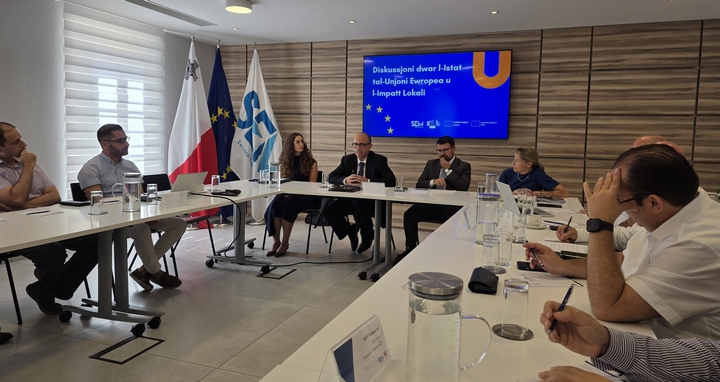
The Parliamentary Secretary for Agriculture, Fisheries and Animal Rights, today addressed the second of the Jellyfish Proliferation and Mitigation Conferences, that started yesterday with a focus on ‘Monitoring and Management of Jellyfish blooms for our Marine Biodiversity & Treatments of Jellyfish Stings’ and continues today with specific attention to the ‘Monitoring and Management of Jellyfish blooms for our Fisheries, Aquaculture and Maritime industries.’
He said that “it is good to note that this initiative, organised by the Department of Biology of the University of Malta in collaboration with other partners from all around the Mediterranean including both European as well as African coasts, is being held on the occasion of the International Day for Biological Diversity proclaimed by the United Nations.”
“Every day, it is becoming more evident that we need to protect our environment in a sustainable manner for our own selves as well as for future generations. Otherwise in the absence of improvement in coastal marine ecosystem health, blooms of certain species like jellyfish or toxic phytoplankton could be sustained and may even spread from the locations in which they now occur. The Ministry for Sustainability, the Environment and Climate change is thus very keen on participating in this event.
The Parliamentary Secretary said, “jellyfish are an important and often conspicuous component of marine food webs, but most of all they are infamous for their direct negative effects on human enterprise, for example by interfering with tourism.
He pointed out that jellyfish blooms, in fact represents “a nuisance for swimmers, and in the case of certain species may become a real health hazard. It was recently estimated that nearly 150 million people are exposed to jellyfish every year.”
“The Mediterranean region is among those heavily affected, as illustrated by the fact that more than 40,000 people were stung during one summer season in the north-western Mediterranean alone. They also have indirect effects on fisheries by feeding on zooplankton and ichthyoplankton, and, therefore, are predators and potential competitors of fish industries.
Moreover, climate scenarios and overfishing in some traditional Mediterranean fishing grounds, may contribute to a further increase in jellyfish outbreaks in this sensitive enclosed sea. Ironically, many human activities may contribute to increases in jellyfish populations in coastal areas.”
Galdes pointed out that “human-induced stresses of overfishing, eutrophication, climate change, translocation and habitat modification appear to be promoting jellyfish blooms to the detriment of other marine organisms.”
He added, “mounting evidence suggests that the structure of pelagic ecosystems can change rapidly from one that is dominated by fish (that keep jellyfish in check through competition or predation) to a less desirable gelatinous state, with lasting ecological, economic and social consequences. The resulting socio-economic impacts – both direct and indirect – are thus tangible.
“Although overfishing, coastal habitat degradation and climate warming are among the most probable drivers, the specific causes and mechanisms are not well identified, and the lack of knowledge makes any further investigation important.”
“Management actions are needed to stop such changes and require a multifaceted integrated response beyond our current traditional management of single environmental issues. Any single management intervention is unlikely to be effective.”
Galdes stated that “what is needed is a combination of coping strategies and longer-term preventative responses based on fundamental and targeted research on this understudied group, which cannot be tackled in isolation but as part of the entire marine ecosystem. Strengthening collaboration and synergy among different regional organisations and initiatives is a basic principle together with the enhancing of the international exchange of knowledge with leading organisations.”
“Moreover the synergy among different disciplines is crucial to understand such complex phenomena. There is still time to avoid higher costs to communities dependent on tourism, fishing, fish farming and other industries. There is still time to prevent greater risks and costs to public health and safety, and also to prevent a great loss of biodiversity in our precious seas,” Galdes said.
“The main aim today is to provide not only to the various stakeholders linked to marine activities and industries, but also to the general public, an opportunity to improve their understanding of our seas and what can be done to look after the environment especially in the local context.”
Galdes said that “while important impacts and solutions to jellyfish blooms in relation to fisheries, aquaculture and other maritime activities might be of special interest to the industrial stakeholders, the general public might be interested to learn about:
· how these creatures, which most of the time are considered as pests, can be used for human consumption;
· how the daily predictions about the distribution of jellyfish, we Maltese have started a habit of checking on the internet, before heading for a swim in summer, are obtained;
· measures which can be used to mitigate stinging jellyfish outbreaks;
· Malta’s contingency plans to mitigate jellyfish blooms locally.
“With all of this in mind,” Galdes said “I would like to wish you all a fruitful meeting, as a concrete effort to raise biodiversity awareness amongst the young generations through environmental education.”
“We hope that through this conference we will build new and strengthen existing networks of young people, educators, and institutions with the purpose of working together in line with UNEP’s theme Many Species, One Planet, and One Future.”