Be the first to comment!
Sea gliders monitor environmental status of the sea around Malta & Gozo
 Email item |  Print item |
|
The experience of using a sea glider, for the first time, in the stretch of sea south of Malta towards the North African shelf, as well as in the offshore areas around the Maltese Islands, has been explained during a half day seminar held in Malta.
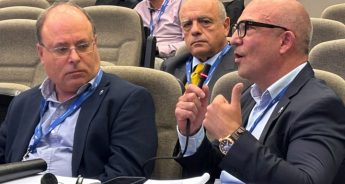
The seminar was organised by the University of Malta’s Physical Oceanography Research Group and attended by key stakeholders and interested parties and showcased how the new generation multi-purpose sea gliders offer an innovative aid to observe and monitor the sea areas under local jurisdiction.
It looked at the versatility of sea gliders as a means of collecting profiles of sea data from an autonomous device that can monitor large sea areas at high resolution and in all sea state conditions without the support of large survey ships.
The head of the Group and coordinator of this project Prof. Aldo Drago, highlighted Malta’s commitments as an EU country to set up by 2020 a comprehensive national system to report regularly on the state of health of coastal waters.
The seminar showed how the use of sea gliders offers a cost-effective solution to achieve a state-of-the-art marine environmental monitoring system capable of collecting baseline data and of routinely assessing the good environmental status of the sea surrounding the Maltese Islands.
He explained that with a “€0.5 million investment it is possible to set up a local fleet of three gliders which would become an integral part of the local operational marine observing system, providing routine monitoring as well as baseline data needed to set up thresholds for the Good Environmental Status of our coastal seas.”
“Having two gliders at sea at any time, and following a track around the Maltese Islands with positions phased half a track away from each other, it is possible to collect a 3D snapshot of the physical, chemical and biological data about the state of the sea around the islands every five days,” Prof. Aldo Drago said.
He added that, “this is a monitoring strategy that fits an island state surrounded 360o by the sea, and would comprise a state-of-the-art system leading other countries to implement monitoring obligations to the EU Marine Strategy Framework Directive.”
Elaborated further on the capabilities of these gliders and on potential applications, foreign experts on sea glider technology.
Dr Anthony Galea described how the sea glider used in this project, CAMPE, conducted two surveys along a transect between the Maltese Islands and the southern Mediterranean shelf.
He said that the sea glider was further employed along a track close to the Maltese Islands, to demonstrate how adaptive monitoring strategies, using remotely controlled unmanned devices, provide cost effective methods to routinely collect basic marine data.
Adam Gauci presented a preliminary analysis of the data, which showed that this data is useful to validate oceanographic models of the area. Furthermore, he said, such data is instrumental in monitoring the sea to ensure that it is maintained in a good environmental state.
Miraine Rizzo, of the Environment and Resources Authority, expanded on this, by describing the level of monitoring that the Authority conducts to ensure that Malta adheres to its obligations.
She gave a comprehensive overview of the monitoring targets, and provided the setting for a brainstorming session held within the seminar to identify bottlenecks and the way forward.
José Herrera, Minister for Sustainable Development, the Environment and Climate Change,and the Rector of the University of Malta, Prof. Alfred J. Vella opened the seminar.
Prof. Vella officially thanked the Commander of the Armed Forces of Malta, Brig. Jeffrey Curmi, for the continuous support that the AFM offered throughout the implementation of this project.
Minister Herrera expressed his appreciation to the University of Malta’s Physical Oceanography Research Group and to all the collaborators of the project for yet another leading research initiative.
He said, “these endeavours truly play a vital role not only to strengthen monitoring capabilities for our marine environment, but also to advocate that the best results can be achieved through cooperation.”
Adding that, “we have to maximise the momentum that has been created so far and focus our energies to coordinate our efforts towards the protection of our marine environment.”
This project is supported by the European Commission – H2020 Framework Programme, through the JERICO NEXT (grant agreement No. 654410) Trans-National Activity.