Be the first to comment!
Ta’ Giezu Crucifix conservation at restoration project completed
 Email item |  Print item |
|
The Ta’ Giezu Crucifix conservation and restoration process has now been completed, in a project financed by the Bank of Valletta.
The Arts Conservation Consortium, headed by Dr Christian Attard, were entrusted by the ArchConfraternity of the Miraculous Crucifix to perform the restoration works as well as extensive studies into the historic and artistic aspects of the Crucifix
 “Very little is known about Frate Innocenzo, the Crucifix’s artist,” said Dr Christian Attard during a press conference to announce the completion of the restoration works.
“His history is documented in his works. It is said that he completed a total of 33 crucifixes, one for each year of Jesus Christ’s life and that the heads of each and every crucifix was found ready by the artist as if by miraculous intervention,” explained Dr Attard.
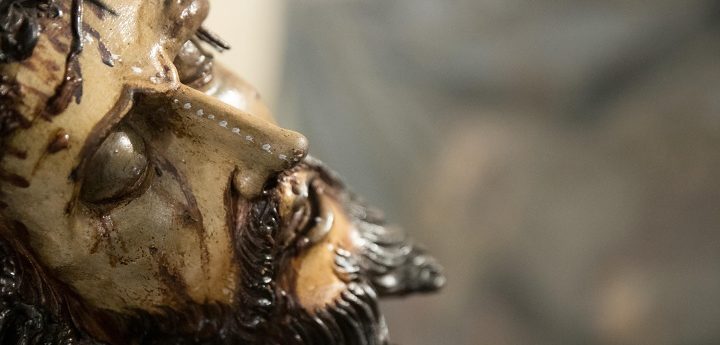
He added that “another legend states that Frate Innocenzo, from Petralia Sottana in Sicily suffered from acute pain in one of his eyes, hence the thorn from the crown passing through the eye in the Ta’ Giezu Crucifix.”
Dr Abela said that “it is not known who commissioned the Crucifix, whether the Franciscan Friars or the ArchConfraternity. The location where the crucifix was sculpted is also unknown, most probably in Malta.”
“What we know is that it is one of the most beautiful crucifixes in Malta, where Frate Innocenzo was free from the wave of celebratory style crucifixes that were being commissioned in Italy at the time, with extreme suffering, as evident in this Crucifix, made unpopular at the time,” he added.
‘The physical attributes of the Crucifix show a 6 foot man going through extreme suffering,” said the Head Conservator, Gozitan Fr Charles Vella. “The Crucifix is made from separate pieces of wood, which are then jointed and nailed together.”
“The statue is so anatomically correct that it implies that Frate Innocenzo must have had some experience with dead bodies to create such perfection,” continued Fr Charles.
“The wood is not carved to absolute perfection as it was then covered with fine layers of gesso. Joints between the wood pieces are also covered in fine linen below gesso layers. The wounds and blood, made from ceralacca and vermilion give it a translucent effect that makes it hard to believe you are not looking at real blood.”
Charles Azzopardi, Executive PR and Marketing at Bank of Valletta said, “we have followed the project closely with the ArchConfraternity and the Consortium and we are very proud to be part of a project that ensures that the Crucifix can continue to be revered by future generations.”
Keith Scicluna from the ArchConfratrnity of the Miraculous Crucifix proceeded to thank all those who participated in this project.
“It is indeed a pleasure to see the Church, the ArchConfraternity, the Consortium, the Bank and the Maltese Community be part of this project and to witness the devotion of this Community towards the Miraculous Crucifix.”