Be the first to comment!
Malta hosts design talks for second phase of world’s largest telescope
 Email item Email item
|  Print item Print item
|
|
Top scientists converge on the Old University Building in Valletta this week to create the software enabling the world’s largest radio telescope to detect every single galaxy in the universe.
Malta will be serving as fertile ground for innovation, with engineers and astronomers from eight different countries discussing the design of the best telescope that can deliver the requirements of the second phase of the telescope – the Square Kilometre Array (SKA).
Starting today, this two-day event is being led by Prof. Kristian Zarb Adami, an astrophysicist with the University of Oxford and the Institute of Space Sciences and Astronomy (ISSA) at the University of Malta.
Prof. Zarb Adami said that, “Malta will be playing a very important role and thanks to funding from the Malta Council for Science and Technology and the Malta Communications Authority our team will be developing the real-time software and system that produces images from the telescope.”
He added that “the objective behind this radio telescope, that spans three continents and taps the brains of over 1,000 scientists from 20 countries, is to discover how the first stars formed in the universe, subject Einstein’s theory of relativity to its most stringent test to date, and shed light on whether intelligent life has developed on other planets.”
Following last March’s creation of the SKA Observatory, a global intergovernmental body that will oversee and operate the gigantic Square Kilometre Array, scientists are moving on to the second phase – SKA-2 – and the concept is inching close to reality.
The Malta meeting will focus on the telescope’s Mid-Frequency Aperture Array, which is the most challenging part of SKA-2 due to its sheer scale.
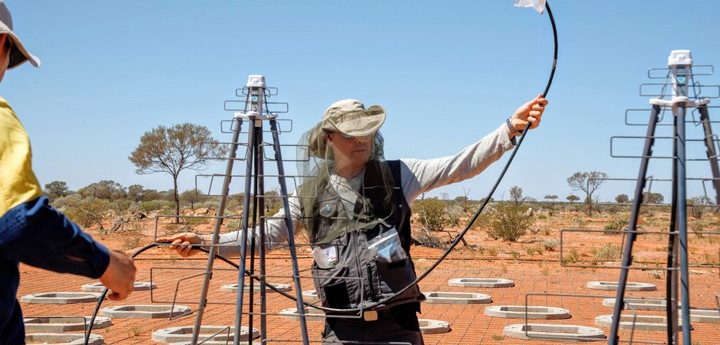
The Institute for Space Sciences and Astronomy within the University of Malta explained that an aperture array is a large number of small, fixed antenna elements that can provide a large field of view and are capable of observing more than one part of the sky at once.
Once construction is completed in 2030, the telescope will be the largest aperture array ever built with approximately 100 million antennas, costing in the region of €1 billion, it said.
“This will be the largest data machine in the world producing more than the entire internet traffic in one day. The SKA will open a new window on our universe and revolutionise how we understand the world around us,” concluded Prof. Zarb Adami
Photo: The international team installing the SKA’s first prototypes in the Australian desert – Credit: ICRAR-Curtin University