Be the first to comment!
21,000 trainees to benefit from over 200 courses
 Email item |  Print item |
|
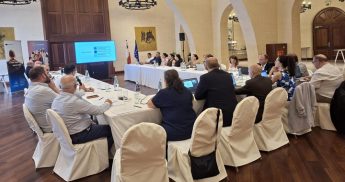
 Minister John Dalli and Parliamentary Secretary Chris Said have launched ETC’s new Employability Programme which is co-financed by the European Social Fund.
The Employability Programme is intended to strengthen the skills and therefore the labour market prospects of jobseekers. It incorporates a collection of initiatives intended to boost the labour market prospects of jobseekers as well as those employed.
The training and retraining programmes include over 200 courses that will be offered to over 21,000 trainees in Malta and Gozo over the coming three years. Labour market integration training will also be offered, including job search assistance initiatives, training in basic skills and work orientation. Persons with little skills or qualifications will be provided basic, remedial skills and vocational training.
Those in employment wishing to upgrade their skills will also be offered retraining programmes in a wide range of areas. In addition to training programmes, ETC will be extending its popular traineeship model of on-the-job and off-the-job training in areas of labour market demand. For persons who have acquired skills but do not hold qualifications, the Employability Programme also provides for the development of a number of occupational standards and assessment, in close liaison with employers and the Malta Qualifications Council. Self-employed persons, and those working in micro-enterprises, will benefit from a refund of 75% of their training cost (up to a maximum grant of € 1,000) when they undertake training approved beforehand by ETC.
Much of this training will be delivered in ETC’s new training centre co-financed by the European Regional Development Fund. Also launched this morning was the second extension to this centre. Work on this extension, which is estimated to cost over €600,000, started this month and is expected to take one year to complete. The new block will consist of 10 training rooms, equipped with the latest technology, and will be adjoined to the old block by a steel bridge. The training complex will be fully accessible to persons with disability.
In his speech Minister Dalli said that work is the foundation of Malta’s social and economic success. The Minister said that we have to appreciate, and develop the skills of our labour force, which is the sole resource of our country in order to give more added value to the county’s economic growth.
The Minister Dalli said that the government is more inclined to emphasise on quality and productivity rather than numbers. In fact he added that by increasing quality and productivity we can increase our output. The Hon. Minister said that Malta should concentrate and organise its workforce on activities that we can compete on and not by taking the easiest short term solutions. He emphasised that we have to change wrong work practices and reconcile the different work ethics that exist between private and public sector.
Referring to a report that had been issues by an EU agency some time ago stating that Malta needs to increase its workforce by 70,000 workers by 2015 to meet its Lisbon Agenda obligations, Minister Dalli stated that such targets will be reached not by adding 70,000 bodies but that we can go a long way by increasing our productivity and therefore increase tens of thousands of man years in effective production.
In his address Chris Said, Parliamentary Secretary for Public Dialogue and Information stated that “employment growth and improvement in infrastructure are a result of investment in human resources. The Government is investing EU funds in projects and initiatives that make a difference in people’s lives.”
Chris Said claimed that during the 2004 and 2006 period, 11,645 people of different ages participated in training courses funded by the European Union. These courses were aimed at various categories of people such as women who want to become entrepreneurs, people with disabilities and the elderly, and these were carried out in different areas such as crafts and ICT.
The ETC schemes in the period 2004-2006 brought about an excellent result, stated Chris Said. The TEES project (Training and Employment Scheme Exposure), for instance, provided training for six months for 460 people who are over 40.
Increasing the rate of working women is another priority for Government. The Government is encouraging more mothers to work or remain in employment and is addressing this objective through several measures. This week a Child Care Centre was opened in MCAST. The past year has also seen the opening of 3 Child Care Centres and this year three new ones will open in Qawra, Pembroke and Siggiewi.