Be the first to comment!
Study uncovers the secrets of young seabirds’ life at sea

 Email item Email item
|  Print item Print item
|
|
A study carried out by Malta-based ornithologists Dr Marie Claire Gatt and Dr Benjamin Metzger as part of The Mediterranean Science Commission (CIESM) International Seabirds Project has uncovered interesting facts about the first movements of young Yelkouan Shearwaters – a stage of life poorly understood and crucial in species conservation.
The Yelkouan Shearwater (Garnija, Puffinus yelkouan) is a seabird native to the Mediterranean and Black Sea. Almost 10% of the total population breed on the Maltese Islands.
The ornithologists explained that between November and July, hundreds of birds grace our cliffs under the cover of darkness as each breeding pair attempts to raise a single chick. Outside this breeding period, Yelkouan Shearwaters leave our shores and remain at sea without approaching land for months, navigating the waves and resting on the water.
With the assistance of BirdLife Malta’s Seabird Team, Gatt and Metzger equipped Yelkouan Shearwaters with GPS-GSM transmitters to track their migration out of Maltese waters at unprecedented spatial and temporal accuracy. The study followed five adult Yelkouan Shearwaters and 14 fledged young, including the members of three shearwater families breeding in nest boxes installed by BirdLife Malta to facilitate the study of these important breeding birds.
Their habits at sea had been a mystery before technological advancements allowed the remote tracking of birds with lightweight devices.
Gatt and Metzger said that the devices are not likely to be retrieved from young birds since they don’t return to the colony in the first years of life and have a low chance of survival, so researchers relied on trackers that transfer satellite positioning data (GPS) by mobile (GSM) network.
The transmitters used in this study are attached to the birds’ back feathers and fall off after a few weeks. The tracks obtained are accessible by clicking here.
The results confirmed that once their chick is almost fully grown both adults abandon the colony. The juvenile bird, which up to this point has only known the rock crevice in which it hatched, takes off into the night all by itself around a week later. Adults foraged in the Central Mediterranean for a few days before migrating east and into the Black Sea, or north into the Adriatic. On the other hand, once the young left the colony, they took off at a north to north-easterly bearing.
Most then flew straight towards the Aegean, from where they presumably also entered the Black Sea, while two flew towards the Adriatic.
Since their parents leave the breeding colony earlier, fledglings cannot follow them to distant destinations at sea. Instead, they rely on navigational cues in their genetics for their first voyages.
The ornithologists stressed that the first year of life is the most dangerous for these long-lived birds, as they have yet to master the necessary skills for a life at sea.
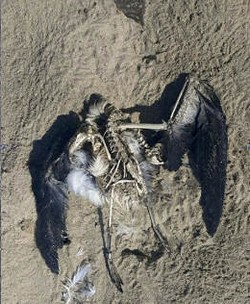 They added that from the 14 young birds that left the colony, one juvenile died while transmitting data and washed ashore on the Egyptian coast, where local colleagues were able to find its remains.
While young are more susceptible to undernourishment and infection, fisheries bycatch, feather oiling, and entanglement in marine debris are threats faced by all seabirds.
Dr Marie Claire Gatt and Dr Benjamin Metzger concluded by saying that, “studying highly mobile animals exposes that the natural world knows no political borders, emphasising the necessity of such trans-national collaborations to effectively protect biodiversity. CIESM’s International Seabirds Project piloted successfully in Croatia in 2021, with the initiative extended this year to Malta and Tunisia.”
BirdLife Malta is currently also running the LIFE PanPuffinus! project with other BirdLife partners across the Mediterranean for the conservation of Puffinus shearwaters.
Photos: A fully-grown juvenile Yelkouan Shearwater fitted with a GPS-GSM device – Photo: Benjamin Metzger; Marie Claire Gatt handles a young Yelkouan Shearwater, hatched inside a nest box in a breeding colony on Malta – Photo: Benjamin Metzger; Yelkouan Shearwaters crossing the Bosphorus into the Black Sea – Photo: Benjamin Metzger and; Not all make it. This tracked juvenile washed up dead on the shores of Egypt – Photo: Adnan Abdel Hamid