Be the first to comment!
HSBC supports Eco-Schools for a global initiative against climate change
 Email item |  Print item |
|
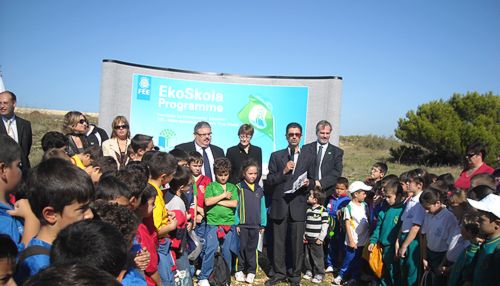 Climate change becomes an international theme for schools supported by the Foundation for Environmental Education (FEE) through the HSBC Eco-Schools Climate Initiative. The programme was launched today (November 17) at the Xrobb l-Ghagin Nature Park and Sustainable Development Centre and was attended by some 300 children from schools in Malta and Gozo.
The schools attending the event were De La Salle, Sta Venera Primary, Guardian Angel Secondary, St Michael’s, St Francis, Theresa Nuzzo, B’Bugia Primary and Xaghra Primary in Gozo.
Eco-Schools in Malta join other 11 FEE delegations from Brazil, China, England, Ireland, Japan, Jordan, Russia, Slovakia, South Africa, United States and Wales to take part in this initiative. This will help schools understand that they can contribute to combating climate change by reducing their CO2 emissions.
The global programme, run jointly by HSBC and the Foundation for Environmental Education (FEE), is backed by a financial commitment from HSBC of US$2.5 million over three years, to teach five- to 18-year-olds about protecting the environment through FEE’s Eco-Schools International Programme. In Malta, HSBC is making available over US$40,000 to run the programme and builds on the Bank’s longstanding commitment to environmental education. The programme is coordinated by Nature Trust (Malta), builds on HSBC’s longstanding commitment to environmental education and is supported by the Ministry of Resources and Rural Affairs and the Directorate for Quality and Standards in Education and Directorate for educational Services within the Ministry of Education, Culture, Youth and Sport.
The HSBC Eco-Schools Climate Initiative will involve HSBC employees initially in the participating countries who will volunteer time to help schools address a variety of environmental themes ranging from energy, transport and waste to water and biodiversity in relation to climate change.
Sally Robson, HSBC’s Chief Operating Officer and Chairperson of the HSBC Cares for the Environment Fund, said: “HSBC is committed to addressing the impacts of climate change and recognises that education is a vital part of the solution. By raising our children’s awareness of the environmental challenges we face and by sharing best practices with them, they will be better placed to make informed decisions and to take corrective action to combat climate change.”
Minister for Resources and Rural Affairs George Pullicino said: “The Maltese Government is aware of the importance of tackling climate change and has taken several steps to mitigate this phenomenon. We need to pull the same rope to heighten the awareness of Maltese citizens on the challenges of climate change – and therefore on the pressing need to change the way we live and operate in our daily lives. I describe our young generation as being the key players of change with regard to the change in mentality needed. This fact is also thanks to the hard work done by the leaders of the programme Eco-Skola.”
Vincent Attard, Executive President of Nature Trust (Malta) – NTM, said that as an NGO it is committed to raise awareness on this issue since this is a problem all citizens of the world have to solve together. “NTM is very happy that Malta has been selected to participate in this joint HSBC/Eco-Schools Campaign and as EkoSkola Malta it will be doing its utmost. Ekoskola has proved to be not only a very strong programme where children and students are being empowered to take an active role but now through this campaign they will be able to take up the lead in climate change and get their families and the whole community involved in taking action. Ekoskola students are meeting the challenges with impressive results. It is encouraging to see a leading NGO together with a leading financial institution and the support of the national authorities all work together towards one goal. NTM thanks HSBC for taking such environmental initiatives for our planet,” he said.
The Eco-Schools Programme incorporates seven steps which schools at any level can adopt. These include doing an environmental review, drawing up an action plan, implementing it and measuring the impacts. Successful Eco-Schools are awarded the ultimate Green Flag, an internationally acknowledged symbol for environmental excellence.
Examples of best practice will be shared through the website www.eco-schools.org to make schools aware of what can be done to address the issue of climate change. A Teacher’s Manual will also be published providing teachers with support materials. The programme will culminate each year with the HSBC Eco-Schools Climate Competition to stimulate the students’ creativity by encouraging them to share their work on climate change by entering a poster competition.
The HSBC Eco-Schools Climate Initiative complements the HSBC Climate Partnership, a five year eco-partnership launched in 2007, with environmental organisations The Climate Group, Earthwatch Institute, Smithsonian Tropical Research Institute and WWF to address the impacts of climate change. The partnership involves the creation of 2,000 “Climate Champions” from among HSBC’s 300,000 global workforce. It is envisaged that some of these champions will lead HSBC’s volunteering efforts in the Eco-Schools. The HSBC Eco-Schools Climate Initiative aims to reach over 100,000 children in its first three academic years. For more information, visit www.eco-schools.org.
Photocaptions: 2272 (from left) Minister for Resources and Rural Affairs George Pullicino, Sally Robson, HSBC’s Chief Operating Officer, and Vincent Attard, Executive President of Nature Trust (Malta) during the launch of the HSBC- Eco-Schools Initiative programme at Xrobb l-Ghagin Nature Park and Sustainable Development Centre.
1288 School children planting a commemorative tree at Xrobb l-Ghagin Nature Park and Sustainable Development Centre together with Minister for Resources and Rural Affairs George Pullicino, Sally Robson, HSBC’s Chief Operating Officer.The Seven Steps of the HSBC Eco-Schools Climate Initiative Eco-Schools involve seven steps that any school can adopt. Based on the elements of an environmental management programme, the process involves a wide range of stakeholders, with students playing the most important part. The HSBC Eco-Schools Climate Initiative aims to implement climate change as a theme in each of the seven steps:
Step 1: Establishment of the Eco-Schools Committee
This is the core of the Eco-Schools process: the Eco-Schools Committee organises and directs the school activities and consists of the stakeholders of the school environment, namely students, teachers, custodial staff, caretakers, parents and representatives of the municipality or local authority.
Step 2: Environmental Review
Work commences with a review or assessment of the environmental impact of the school. Students are involved in this work, ranging from assessing the level of litter on school grounds to checking infrastructure for inefficiencies.
Step 3: Action Plan
The information gathered in the review is used to identify priority areas and create an action plan, setting achievable and realistic targets and deadlines to improve environmental performance on specific issues.
Step 4: Monitoring and Evaluation
The Monitoring and Evaluation step is meant to assess the progress towards the targets that have been established, to point out any changes that are necessary in the action plan and ensure that achievement is celebrated. It further ensures that environmental education and care is an on-going process in the school.
Step 5: Curriculum Linking
Classroom study of themes such as energy, water and waste are undertaken by most students. The whole school should be involved in practical initiatives, such as saving water, recycling materials and ways in promoting the prevention of litter. In the cases in which environment and sustainable education are not a part of the national/regional curriculum, recommendations are made as to how this could be incorporated. Efforts should be made to incorporate environmental education throughout the curriculum, in addition of the inclusion in the more evident areas of study such as science and geography.
Step 6: Informing and Involving the wider Community
This step brings Local Agenda 21 into schools, involving parents, local authorities, businesses and the wider community in the Eco-Schools process. Eco-Schools are encouraged to make ties with external organisations in order to benefit from their experience and expertise. Eco-Schools are also encouraged to consider the wider community when preparing action plans and to keep the wider community informed of their actions through classroom displays, school assemblies and press coverage. This step is essential to ensure that tangible awareness raising and behavioural changes widen outside the school.
Step 7: Eco-Code
Each school produces its own ‘Eco-Code’, a statement of values and objectives, outlining what the students are striving to achieve. After a period of participation, an evaluation of the success of these initiatives and the methodology is undertaken, and the whole Eco-Schools programme for each school is assessed. Successful Eco-Schools are awarded the Green Flag, an internationally acknowledged symbol for environmental excellence. In some countries, this recognition happens through a three level system, were schools are awarded either bronze and silver prizes before getting the green flag, or one and two star prizes.