Be the first to comment!
Proposed principles and safeguards on assisted voluntary euthanasia
 Email item |  Print item |
|
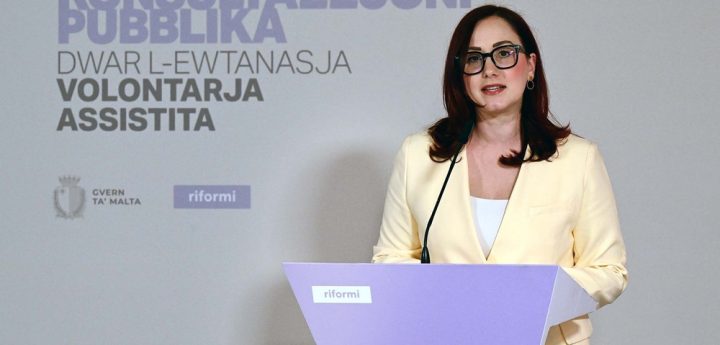
A public consultation process on assisted voluntary euthanasia was launched earlier today on assisted voluntary euthanasia for terminally ill persons.
Parliamentary Secretary for Equality and Reforms, Rebecca Buttigieg, announced this during a press conference, where she launched a document for public consultation that establishes certain principles and safeguards as a basis for the discussion.
She explained how the government must listen to and consider everyone’s opinion during this sensitive consultation, which must be held in the context of persons who are experiencing unbearable suffering for which there is no cure.
“This discussion in our country and our society did not begin today, but this is the first occasion that society will have a set of principles, criteria and safeguards that provide a serious framework for an informed and mature consultation. Therefore, it is crucial that the discussion is conducted with compassion, in a dignified and respectful manner. We must listen to each other with open hearts and minds,” said Parliamentary Secretary Buttigieg.
The parliamentary secretary said that in preparation for this public consultation, a technical committee composed of medical and legal professionals was appointed that analysed the most ethical practices of countries that have laws regulating voluntary euthanasia and drew up these strict principles and safeguards to offer a basis for a serious and mature consultation.
The principles outlined in the consultation document stipulate, among other things, that voluntary assisted dying can only be requested by individuals over the age of 18 who are suffering from a terminal illness which is medically certified to result in death within six months.
The document makes it clear that old age, disability, or mental health conditions can never be valid grounds for requesting assisted voluntary euthanasia, the Parliamentary Secretary said.
Among the proposed safeguards is a provision making it a criminal offence to encourage or pressure someone into requesting assisted voluntary euthanasia.
Parliamentary Secretary Buttigieg explained that the document includes several safeguards, including a requirement for the medical team to inform patients with a terminal illness about palliative care services, which the government is committed to continuing to invest in and strengthening.
She added that it is being proposed that a request for assisted voluntary euthanasia can only be made autonomously by the individual suffering from the terminal condition, and that the request must be supported by three medical certifications, including one from a psychiatrist.
A strict and rigorous review process is also being proposed, one that is overseen by a regulatory board chaired by a former judge, which must grant final approval following a reflection period. At any point, the individual may withdraw their request for assisted voluntary euthanasia.
Members of the medical profession have the right not to participate in the process leading to voluntary assisted euthanasia if the patient in their care so requests, based on their conscientious objection. However, they are obliged to refer a person who voluntarily requests voluntary assisted euthanasia to other professionals.
As part of this public consultation, it is also being proposed to introduce the right to create an advance directive or “living will”. Parliamentary Secretary Buttigieg clarified that this would not grant a right to request assisted voluntary euthanasia unless all eligibility criteria are met. Rather, through a living will, a mentally competent individual, following consultation with a trusted medical professional, can formally declare what types of treatment they wish or do not wish to receive for certain future medical conditions.
The public consultation is open until the 2nd of July, and the public is encouraged to participate and submit their feedback online at www.facts.gov.mt or during three community meetings to be held in Fgura, Mosta, and Gozo.
Photo: DOI/Pierre Sammut