 1 comment.
Dwejra public observation night – Why Dwejra must remain dark

 Email item Email item
|  Print item Print item
|
|
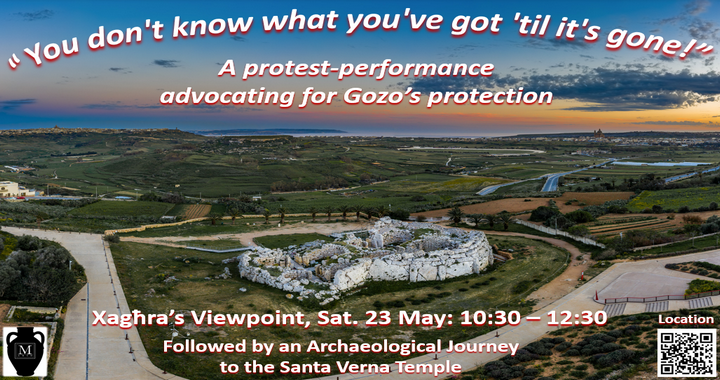
The Astronomical Society of Malta is organising a public observation night at Dwejra in Gozo to raise awareness of why Dwejra must remain dark.
As many may already know, the recently published Dwejra Protection and Management Regulations would allow artificial lighting to be introduced at Dwejra, which, the Society said, is “one of our last truly dark places and a designated Dark Sky Heritage Area.”
It warned that while presented as “mitigation,” these measures “fall far short of real protection. At Dwejra, there is no such thing as acceptable lighting.”
The Astronomical Society of Malta said that’s why, together with several other organisations, it is inviting the public to a special open night-sky observation at Dwejra.
This is the public’s “last chance to experience Dwejra as it is meant to be: under a naturally dark sky, filled with stars, planets, and wonders rarely seen elsewhere in the Maltese Islands,” the Society said.
Through guided observations and shared views of the night sky, the Society said it hopes to “show not just tell you, why darkness matters, and why Dwejra must remain untouched.”
Everyone is invited. The society stated that “the more people who attend, the stronger the message we send on this critical night for Dwejra’s future.”
The date to remember is – Friday, the 20th of February, starting at 7pm. The Society said that no registration is required for this event, simply turn up on the day.
Please also see this article
Photo: The Astronomical Society of Malta














I will surely attend. My eyes needs it.
darkness is a form of exercise for your eyes. In our modern world, we are constantly bombarded by artificial “flat” light (screens, LEDs, streetlights).
1. Pupillary Dilation: In total darkness, your iris muscles relax to allow the pupil to open to its maximum diameter.
a) The Benefit: Just like a muscle that stays contracted all day gets stiff, an eye that never experiences deep darkness loses its “range of motion.” Allowing your pupils to fully dilate and then slowly constrict helps maintain the flexibility of the iris.
2. Activating the Rods (Scotopic Vision)
a) Our retinas have two main types of photoreceptors: cones (for color and detail in bright light) and rods (for movement and light sensitivity in the dark).
b) In a brightly lit city, your rods are essentially “turned off” or bleached out. When you spend time in a dark place:
c) Dark Adaptation: It takes about 20 to 40 minutes for your eyes to fully adapt. During this time, a protein called rhodopsin (visual purple) regenerates.
d) Peripheral Awareness: Using your rods improves your peripheral vision and your ability to detect subtle movement, which is a primitive but vital part of human health.
3. Circadian Rhythm and Eye Health
a) Darkness isn’t just about what you see; it’s about what your brain signals.
b) Melatonin Production: Real darkness triggers the pineal gland to produce melatonin. While we think of this for sleep, melatonin is also a powerful antioxidant that protects the cells in your retina from oxidative stress.
c) Recovery: Constant exposure to artificial light (especially blue light) can lead to digital eye strain. True darkness is the only time the ocular system can “reset” and recover from the high-energy wavelengths of the day.
d) The Magic of “Averted Vision”
e) Astronomers use a trick called averted vision. Because the center of your eye (the fovea) is packed with cones that don’t work well in the dark, you actually see faint stars better by looking slightly beside them. This uses the rods on the edges of your retina. It’s a profound experience to realize you can “see” more by not looking directly at it!
f) The Verdict: Darkness is absolutely essential. It prevents “light pollution” of the body, keeps your iris flexible, and allows your retina to regenerate vital proteins.