Be the first to comment!
Dwejra’s nocturnal landscape is a cultural asset at risk – Academics
 Email item |  Print item |
|
 135 academics affiliated with the University of Malta have issued a joint statement regarding the controversial legal notice on artificial lighting at Dwejra issued by the Environment and Resources Authority.
The academics described it a a “particularly troubling.document” and this joint statement will be submitted as feedback on it in the current public consultation period.
“Dwejra is far more than a scenic coastal site. It is a rare cultural and intellectual landscape whose value extends across multiple academic disciplines. In a country increasingly dominated by artificial light and visual intrusion, Dwejra has remained one of the last places where the natural rhythm of night still survives. This darkness is not merely an environmental condition, but a defining element of the site’s cultural, educational, and scientific significance,” the academics said.
They noted that “for years, Dwejra has served as a shared resource for scholars and students from diverse fields. While it has been indispensable for astronomical observation, its importance reaches well beyond the physical sciences. The site has supported learning and research in environmental studies, ecology, geography, heritage conservation, education, and the humanities. Its unaltered night environment provides a living context in which students can explore humanity’s historical relationship with the sky, the sea, and the natural world.”
The academics stressed that “he experience of a truly dark night sky carries deep cultural meaning. For millennia, societies have used the stars for navigation, storytelling, timekeeping, and ritual. At Dwejra, these connections remain tangible.
“The site offers a rare opportunity to engage directly with the same night sky that shaped language, belief systems, art, and early scientific thought. Such encounters are essential not only for scientists, but also for historians, anthropologists, educators, and artists seeking to understand how human culture has been shaped by the natural environment.”
They noted that Dwejra has also played an important role in public education and cultural outreach. “It has enabled meaningful engagement with the wider community, particularly with younger generations who are growing up with little or no experience of natural darkness.”
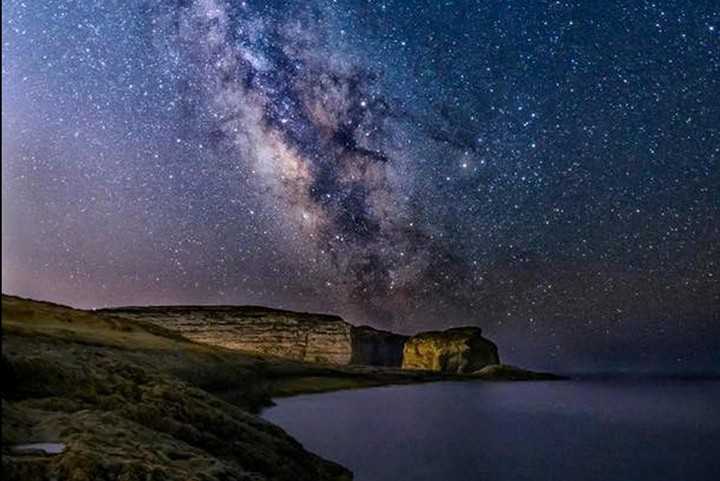
In Dwejra, many visitors behold for the first time the Milky Way amidst a sky peppered with stars. “These moments are formative: they inspire curiosity, reflection, and a sense of belonging within a larger natural and cultural continuum,” the academics said.
They stated that “given this breadth of value, the expectation has always been that Dwejra would be managed with exceptional care. Cultural landscapes of this kind are fragile. Once their defining characteristics are compromised, they often cannot be fully restored. Protection, therefore, is not simply a technical matter, but an ethical responsibility to future generations and to the integrity of the site itself.
“It is in this context that the recent legal notice issued by the Environment and Resources Authority is particularly troubling. It permits artificial lighting at Dwejra until midnight; limits restrictions to newly installed fixtures while ignoring existing illegal lighting; and invokes ambiguous notions of “permanent” lights.”
The academics warned that “thereby, the legal notice compromises the darkness that underpins the site’s scientific, educational, and cultural value.
“This approach contradicts the Gozo and Comino Local Plan, which designates Dwejra as a Dark Sky Heritage Area under Policy GZ-DARK-1. More broadly, it reflects a failure to recognise darkness as a cultural asset, not merely an absence of light.”
They stressed that “the night sky forms part of our shared heritage, just as much as built monuments, landscapes, and traditions. Malta risks eroding one of its last authentic night landscapes.”
The academics concluded by urging the responsible authorities and policymakers” to reconsider this decision. If Dwejra is to remain a site of cultural, educational, and scholarly importance across disciplines, artificial lighting must be excluded entirely.
“Anything less represents an irreversible loss – not only to science, but to culture, history, and the collective human experience of the natural world.”
ThisFriday, the 20th of February, at 7pm, the Astronomical Society of Malta is organising a public observation night at Dwejra in Gozo to raise awareness of why Dwejra must remain dark. Everyone is invited to attend.
Objections against the Legal Notice can be made to era.policy@era.org.mt by the 3rd of March.
File photo: Wirt Ghawdex