Be the first to comment!
MCAST launches over 100 free industry-focused courses
 Email item Email item
|  Print item Print item
|
|
Following an extensive consultation process involving 10 different industry sectors, the Malta College of Arts, Science and Technology (MCAST) is launching over 100 free training courses to Maltese and Gozitan workers and job seekers.
These learning opportunities are the second phase of an EU-funded project (ESF2.85), entitled Linking Industrial Needs and Vocational Education and Training (VET), which MCAST is coordinating in collaboration with the Institute of Tourism Studies (ITS), the Malta Qualifications Council (MQC), and with the support of the Malta Chamber of Commerce, Enterprise and Industry. The project originally intended to provide training to 450 individuals. However, this figure is likely to increase significantly as the number of employers who expressed interest in encouraging their staff to participate was much higher than expected.
The short courses will provide training to current or future employees in the Beverages, Financial Services, Food, Furniture, ICT, Infrastructure, Maritime, Pharmaceuticals and Chemicals, Plastics and Printing sectors, which represent almost 30% of the Maltese workforce.
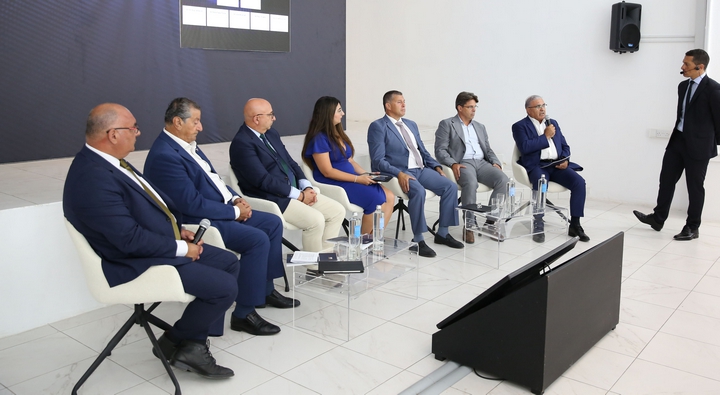
Details of this project were presented on Thursday 12 January during a business breakfast at The Palace Hotel, in Sliema.
The first phase of the project involved the setting up of groups of representatives from each industry sector to identify the qualifications and skills that current and future workers require to ensure the continued growth of the sector, and to enhance their employment prospects. This was complemented by sector-specific surveys among 145 local companies, to learn more on the training needs of Maltese workers, explained Ms. Amanda Borg, on behalf of E-Cubed Consultants, the company contracted to assist in this study.
Almost 70% of respondents indicated that they actively encourage their employees to take up lifelong learning courses, while 80% consider such continuous training as an important factor for career advancement.
Further information on these new training modules will be available online, on www.mcast.edu.mt, soon. Training will be held twice weekly, in the evening. The first sessions are expected to begin in March and will continue throughout the next two years, explained Mr. Ronald Curmi, the Project Leader and Deputy Director of the MCAST Institute of Electrical and Electronics Engineering.
Prospective learners may apply for more than one module, depending on the skills they need to acquire. Candidates who successfully complete several modules will be awarded customised awards recognising their achievements in each module, and may also qualify for an over-arching award.
Dr. James Calleja, Permanent Secretary in the Ministry of Employment and Education announced that in the coming weeks, the Government will be presenting in Parliament the necessary legislation to introduce a legal framework for the accreditation of experiential learning, to provide qualifications to those workers who have acquired skills through years of work experience, rather than formal training. This will open up new career advancement and further training opportunities for these workers. “Our greatest challenge now is to ensure that by the time they turn 16 and end their obligatory education, everyone has the necessary basic skills to successfully participate in further education, and to acquire the required flexibility to adapt to the ever-changing and competitive conditions of the world of work.”
MCAST President Mr. Joseph Farrugia highlighted the importance of the fact that industry representatives are being directly involved in the design of the courses, making sure that they truly provide the skills that the industry requires and that can make individuals more employable. “Malta’s ability to survive and grow in the current adverse global economic conditions relies strongly on its ability to adapt to a changing economic environment, which in turn depends on the flexibility and quality of its labour force. Through this project, the country is upgrading the skills of its people and matching them with the requirements of numerous sectors,” Mr. Farrugia added.
Dr. Philip von Brockdorff, the MQC’s CEO, explained that it is important for Malta to establish the required infrastructure to increase the participation in lifelong learning, because this is an important factor for economic growth. Mr. Joe Tanti, Vice Chairman of the ITS, explained that in certain industries, such as the Food and Beverage sector, there are many older workers who have been in the same job for years, and who will find it more difficult to engage in lifelong learning than younger individuals who are more familiar with today’s teaching technologies, including IT. Thus, it is important for lifelong learning initiatives to make an extra effort to reach out to these workers as well.
It has now become impossible for employers to ignore lifelong learning, explained Ing. Ray Muscat, Director General of the Malta Chamber. Even trade unions are now giving it importance when they come to negotiate workers’ collective agreements. Investment in lifelong learning will help to increase workers’ flexibility, which in turn makes them more employable. Prof. Maurice Grech, MCAST Principal and CEO, explained that the new courses that are being announced in the coming days are not MCAST’s only commitment to lifelong learning. The College has recently embarked on another €7 million EU-funded project to introduce new lifelong learning opportunities through e-learning, accreditation of experiential learning, as well as accreditation of prior learning. This project should lead to even more training opportunities within the next three years.