Be the first to comment!
Gozo debates focus on the Gozitan identity & need for holistic strategy
 Email item Email item
|  Print item Print item
|
|
Two debates that the European Parliament Information Office organised in Gozo yesterday focused on the Gozitan identity in the European context and particularly on the need for a holistic strategy for the island that would give its people a clear idea of where they are heading.
The first debate was an academic one, with presentations by Godfrey Baldacchino, Rose Marie Azzopardi, Damian Spiteri, Liberato Camilleri and Ryan Mercieca. Gozo Minister Anton Refalo delivered the opening address and participated actively in the discussion, which was held at the University of Malta campus in Xewkija.
The second event was held at Il-Hagar – Heart of Gozo, a museum and cultural centre in Victoria displaying a rich collection of historical and artistic artefacts that were previously inaccessible to the public.  The event included discussions on business and investment, employment, and fisheries and agriculture, with the participation of experts in the three sectors. The closing debate focused on Gozitans’ expectations and perspectives of the EU and the European Parliament.
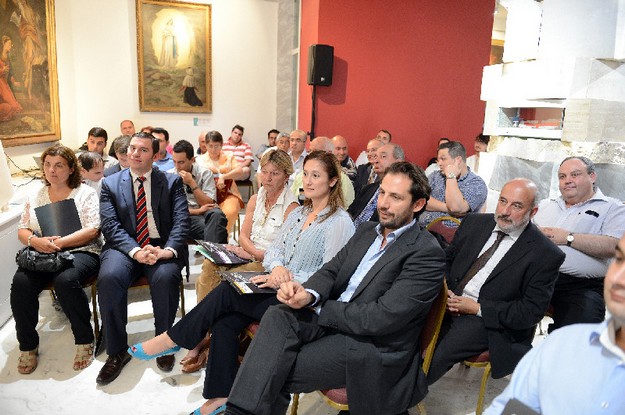 It was moderated by Vanessa Macdonald, business editor at Times of Malta. Some of the candidates for the May 2014 European Parliament elections – Lino Bianco, Clint Camilleri, Therese Comodini Cachia, Kevin Cutajar, Helga Ellul, Cyrus Engerer, Stefano Mallia, Kevin Plumpton and Jonathan Shaw – participated in the debates.
During the morning discussion, Gozo Minister Anton Refalo pointed out that “Gozo’s solutions start from our place in Europe” and stressed that the island requires a holistic strategy to address its particular problems.
He said the government intends opening a National Statistics Office in Gozo, as well as a Gozo office in Brussels as a means of ensuring that the island has the necessary means to make a good case for itself if it wants to lobby to be considered as a region in its own right, or when tapping particular EU funds, for instance.
Rose Marie Azzopardi, from the University of Malta’s Department of Economics, presented a paper that evaluates two types of recent migratory flows affecting the Maltese archipelago: international migration to and from the islands triggered or intensified by European Union membership; and domestic, inter-island movements between the ‘mainland’ (Malta) and the smaller island (Gozo).
Dr Azzopardi’s conclusions suggest that emigration remains an overall positive experience at the individual level, with constructive spill-over effects, mingling of cultures and better use of resources at the national level. Such benefits can be expected to increase if authorities design policies which encourage rather than discourage migratory flows.
Godfrey Baldacchino, from the university’s Department of Sociology, said Gozitans need to decide what they want Gozo to be: “Gozo has a choice – it can either be part of Malta, or it can get the status of ‘region.’
Should Gozo mirror Malta or develop its own strategy?” Prof. Baldacchino gave examples of several peripheral islands that have proven to be very successful in a number of sectors such as financial services, IT and insurance. “Why not develop a top level domain for Gozo such as ‘.go,’ for instance?” He asked.
Ryan Mercieca, Damian Spiteri, and Liberato Camilleri (who could not be present for the event), on their part, presented the findings of their research ‘Am I Gozitan, Maltese or European? Citizenship in a European Context – a Gozitan perspective.’
They explained that most students who participated in their study said that they get two main messages from home and from society – that opportunities in Gozo are limited and that Gozo has a more relaxed lifestyle than Malta. A cardinal aim of the study was to understand how young Gozitans manage and negotiate their lives.
To do this, the researchers presented a questionnaire to students at the sixth form at the Ninu Cremona Complex (and held a focus group as a follow-up to this), looking at institutions such as the family, school, peer groups, the media and other agents of socialisation, and their impact on the students’ lives.
92.5% of the students said that they aspire to go to university. The researchers found that for some, attending university is seen as a ‘rite of passage,’ since they see it as a period where they would leave their families and neighbourhoods to go and live in Malta, which is a ‘different’ island.
The study explains that in terms of ‘islandness’, this is significant since it clearly illustrates a distinction between ‘physical islands’ and ‘islands of the mind’, which refers to the social and cultural space that makes islands what they are (for example the University of Malta means something to Gozitans that it does not mean (necessarily) to the Maltese.
Some of those who participated in yesterday’s discussions spoke about the Declaration on the ‘Island Region’ of Gozo, included in Malta’s Treaty of Accession to the EU, with some saying that it hasn’t got any legal basis and that someone needs to act upon it for it to have any form of effect.
During the evening debate, participants spoke about the lack of employment opportunities in Gozo, the issue of accessibility (also for investors), the need for people to be better informed about the EU and for Gozo to benefit more from EU membership, and especially the need to decide on a coherent strategy in terms of where Gozo is heading.
Photographs at Il-Hagar – Heart of Gozo by Rene Rossignaud