Be the first to comment!
A species of rose saved from local extinction at Wied il-Lunzjata
 Email item |  Print item |
|
Stephen Mifsud, an employee at EcoGozo Rural Development Directorate, within the Ministry for Gozo, has discovered a species of rose that only occurs in the Lunzjata valley within the Maltese islands. It is called the Sweet Briar Rose (Rosa rubiginosa).
Stephen describes his story below of this wonderful discovery, together with the recovery and conservation efforts of the Sweet Briar Rose:
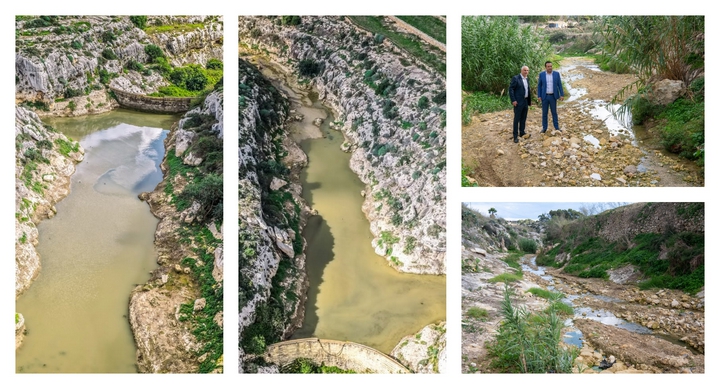
"Wied il-Lunzjata is a fertile valley running between the rocky uplands of Kercem and Fontana, and streaming west towards Xlendi where its water course flushes at Xlendi Bay. It is a shallow valley lined by lush agricultural fields, fruiting trees and water canals of great antiquity.
Parts of its valley bed were once covered by very ancient stone slabs, some of which are still in place, indicating that the valley was once maintained and taken care of by our ancestors, possibly to make best use of its natural water.
 It is the only valley in Gozo that is supplied by permanent freshwater springs and forms a continuous watercourse all year round hence providing the only dwelling in Gozo (together with Xlendi) to the endemic and protected Fresh Water Crab (Potamon fluviatile subsp. lanfrancoi, il-Qabru). Its perennial natural water is a godsend both for the ecology of this valley and the surrounding agricultural produce.
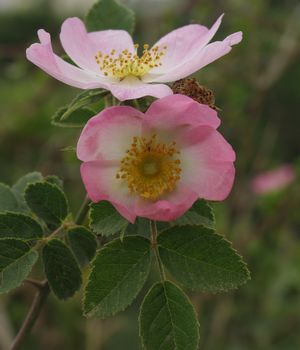
It is here that I discovered the Sweet Briar Rose (Rosa rubiginosa) which is characterised by baby-pink, single flowers with a white centre, slender hooked thorns, and pinnate leaves giving off an apple-like fragrance due the presence of an oily substance secreted by translucent glands.
It is a non-climbing shrub that drops most of its leaves in winter, although some may persist in mild winters. The flowers appear between May and June, and later in the year, it forms red inedible berries known as hips.
In its native range, hips are usually opened and consumed by birds which facilitate seed dispersion, but in Gozo, this rose had only persisted vegetatively.
It is presumed to be a relic of old cultivation which had remained adorning the valley for many decades. Possibly, it was introduced by the British since during the Second World War, soldiers used to take tea from rose hips to get their supply of Vitamin C.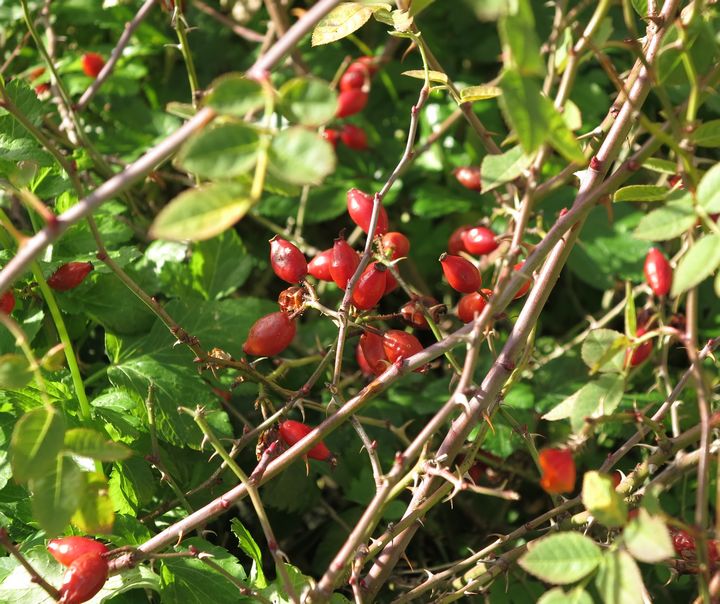 While surveying the biodiversity of this valley around March 2016, I found this rose to be seriously damaged. Consequently, EcoGozo within the Ministry for Gozo had taken all measures to salvage the species.
Conservation measures that were taken included shelter of the rose from wind to protect the emerging shoots; watering at regular intervals during the warm months of May and June and occasional supplement of nutrients.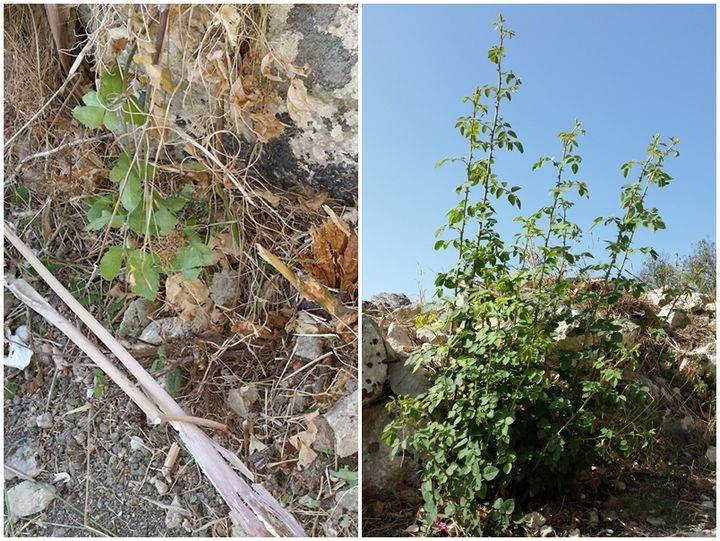 As they say, nature is full of miracles and the sweet briar rose had recovered and currently reaching a height of 120cm. Hopefully it will set flowers next year.
For improving the conservation of this species, it is planned to propagate it using appropriate methods and introduce it in adequate places and parks within Gozo and Malta so that the public can admire."
Photographs of the Sweet Briar Rose flowers, hips, and the plant before and after recovery by Stephen Mifsud and EcoGozo