 1 comment.
Ancient quarry discovered on site of planned Gozo Middle School extension
 Email item Email item
|  Print item Print item
|
|
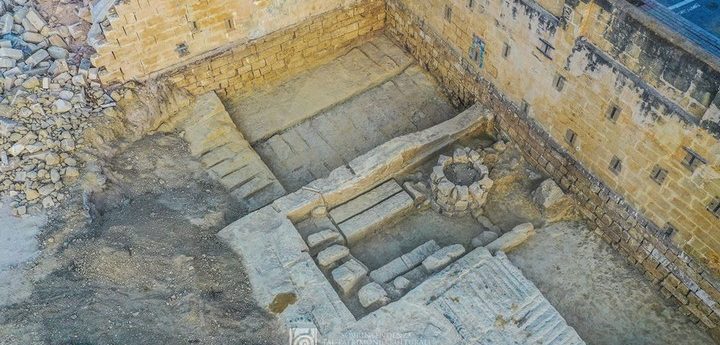
 An ancient quarry has been discovered in Victoria during archaeological investigations being directed by the Superintendence of Cultural Heritage, in preparation for the extension of the Middle School at Victoria, Gozo.
The Superintendence explained that this quarry forms part of the Roman quarry discovered underneath the adjacent school during works for its conversion into the Gozo Museum, and both have been tentatively dated to the 3rd and 4th century AD on the basis of the pottery found on site.
In addition, the Superintendence said that the ashlars being quarried on this site follow standards in use during the Roman period.
“A matter of utmost interest is that in the case of Gozo, little if any such features were recorded and therefore these quarries would be the first properly recorded discovery of Classical period quarrying in Gozo,” it said.
The Superintendence went on to explain that “this discovery is even more of interest as the quarry complex discovered to date covers a vast area of over 5,000 square metres, some of it still covered by the surrounding school complex.”
The ashlars were extracted, it said, by ancient traditional manual methods, which were still employed in local quarrying up to the introduction of machinery in the early 20th century, though in more recent times the size of the ashlars is much smaller.
This ancient quarry is about 1 to 2 metres deep and has two distinct characteristics: the clearly defined uncut blocks waiting to be extracted, and the negative void of the already extracted blocks.
The quarry cuts and unfinished blocks still in situ indicate that various types of blocks are being quarried including ashlars, slabs and possibly corbels. Evidence of stone dressing on site is also evident, the Superintendence said.
A vaulted cistern connected to two wells has also been discovered within the quarry. This is currently being studied to understand whether it was constructed as part of the quarry activity or is of a more recent date.
Also of interest is a number of amphorae laid out radially, discovered in a different section of the quarry. The Superintendence said that amphorae were usually used for the transportation of food and drink and it is not yet clear whether they were being used in conjunction with the quarry or whether they were being stored on site.
The Superintendence said that the destination of the stone blocks from this quarry was possibly for building projects in the ancient city of Gaulos (Both the island and its city Gaulos/Gaudos are mentioned by a number of Greco-Roman authors in their texts, such as Diodorus Siculus, Strabo, Pliny the Elder, Ptolemy and Procopius among others) in the location of the present Cittadella and Victoria in view of its proximity.Of particular interest to Gozo in this context is the Punic inscription known as the Melitensia Quinta (CIS, 1, 132) discovered in Gozo, which mentions the keeper or inspector of the quarries, although it cannot be identified with the site in question with any certainty, it said.
The Superintendence of Cultural Heritage said that it has engaged extensively with this project from the outset during the consultation process of the planning application by providing recommendations to the Planning Authority and the project team.One of the recommendations made by the Superintendence was for the works to be monitored by an archaeological monitor approved by the Superintendence.
“It is thanks to this monitoring that the archaeological features in question are being discovered, investigated, documented and preserved,” the Superintendence said.
Discussions are ongoing between the Superintendence and the Foundation for Tomorrow Schools to find solutions on how to preserve and integrate the discoveries within the project.
“Whilst understanding that time and funding restrictions are at a premium,” the Superintendence said that it noted with “great satisfaction and appreciation that the Foundation for Tomorrow Schools are making the necessary efforts to preserve this heritage.”
It said that the state of preservation of this ancient quarrying is rather good despite the construction of the school grounds and car park over it in the 1960s, since at the time, no basement was cut.
“The preservation and integration of the recently discovered ancient quarry remains at the site of the Rabat Middle School is highly commendable and has the endorsement of the Superintendence of Cultural Heritage.”
Photos: Superintendence of Cultural Heritage – Joseph Grima















As the general public is becoming much more conscious by & with our national heritage, preservation of such sites have & must be protected for us and future generations to come.
It was a common policy in past years for individuals and also governmental personnel to quickly bury any ancient remains so as to continue with building. This was done in fear of having the area confiscated by the authorities and left with no alternative.
Nowadays, as people are becoming more conscious of their national heritage and remedies are found, historical finds are being more protected.
What I still cannot understand is why many of these historical artifacts are reburied once more.
For example, just before the Cathedral Church Steps at the Citadel, an old remains of a circular object was discovered but reburied once again when this easily could have been covered with glass and left for the public to see. Also so many other items were found & reburied at the Citadel when doing reconstruction works & reburied once more.
Pictures were taken and registered, BUT these are not exposed for the general public to see.