Be the first to comment!
ICOMOS “gravely concerned” over “apparent irregularities” of Ggantija permit
 Email item Email item
|  Print item Print item
|
|
 ICOMOS Malta has voiced its concerns about “apparent irregularities” in the granting of a building permit at Ggantija, Xaghra, Gozo.
The Maltese National Committee of International Council on Monuments and Sites (ICOMOS) said in a statement on Tuesday, that it is “gravely concerned” by the decision taken by the Planning Authority last Thursday regarding a building application within the World Heritage Site Buffer Zone formally recognised by UNESCO.
ICOMOS said that “there are grounds for concern that the decision may have been taken on the basis of incorrect statements made by the applicant’s representatives during the hearing, regarding the extent of the UNESCO World Heritage Site Buffer Zone.”
For clarity, it said the facts of the matter are repeated here.
“The extent of the Buffer Zone of the UNESCO World Heritage Site submitted by the Maltese Government corresponded to the Area of Archaeological Importance created in 1998 around Ggantija (Government Notice 357/1998).
The site boundaries submitted by Maltese Government, inclusive of the World Heritage Site Buffer Zone corresponding to the Ggantija AAI, were formally noted by the UNESCO World Heritage Committee in 2006, in Decision 30 COM 11A.2(https://whc.unesco.org/en/decisions/1195).
In August 2010, the AAI around Ggantija was enlarged by the Planning Authority (Government Notice GN 853/2010). In 2015, the Maltese Government submitted a Minor Boundary Modification to the Buffer Zone of Ggantija, which may be viewed here: https://whc.unesco.org/en/documents/139812
This modification enlarged the World Heritage Site Buffer Zone to reflect the 2010 increase in the AAI. The site of the proposed building works is INSIDE this enlarged World Heritage Site Buffer Zone.
In response, the WH Committee, in its 39th session in 2015, took Decision 39 COM 8B.46, to approve the boundary modification proposed by Malta, which may be viewed here: https://whc.unesco.org/en/decisions/6396.”
ICOMOS explained that “during last Thursday’s hearing, the applicant’s representatives reportedly referred to a smaller, circular buffer zone around Ggantija to argue that the site of the proposed works were outside the Buffer Zone of the World Heritage Site.”
It pointed out that “this circular area simply represents the MINIMUM requirement for ANY Grade A archaeological site in Malta.”
ICOMOS stressed that Although shown on the PA MapServer, “it does not appear to have been formally defined in a Government Notice, and it was NEVER submitted or proposed to UNESCO as the Buffer Zone of the World Heritage Site.”
“If it is confirmed that erroneous or misleading statements about this were made during the hearing, and not corrected by the Planning Directorate or the Chair, it would raise very serious doubts about the validity of the decision,” stated ICOMOS.
It insisted that “the decision to grant this permit without presenting and evaluating a Heritage Impact Assessment also raises grave concerns about good governance, as it is is a direct challenge not only to UNESCO, but also to the authority of the Maltese Government, which had agreed that an HIA should be presented.”
ICOMOS went on to say that “the decision is also in direct defiance of the state institutions entrusted with the stewardship of Malta’s cultural heritage, particularly the Superintendence of Cultural Heritage and Malta’s National World Heritage Technical Committee, which were all agreeing on the need for the Heritage Impact Assessment and investing their best efforts in achieving this goal.”
ICOMOS Malta appealed to the Chairman of the National World Heritage Technical Committee to make public all its workings to date regarding this case.
ICOMOS Malta further appealed to the Prime Minister and to the Minister of Culture, who is vested with the powers and responsibilities defined in the Cultural Heritage Act, “to take a public stand on this matter and to redress it before more damage is allowed to take place to Malta’s reputation, and before this is allowed to translate into material and economic damage.”
The Maltese National Committee of ICOMOS was formed in 1997. In accordance with the charters of the International Organisation, the principal aims of ICOMOS Malta are to assist in the investigation, preservation and enhancement of the values of cultural heritage, cultural monuments, historic areas, towns and sites, as well as the wise use and promotion of heritage.
ICOMOS said it also aims to encourage the adoption of international conventions, to bring together highly qualified professionals and to create centres specialising in conservation management nationally and internationally.
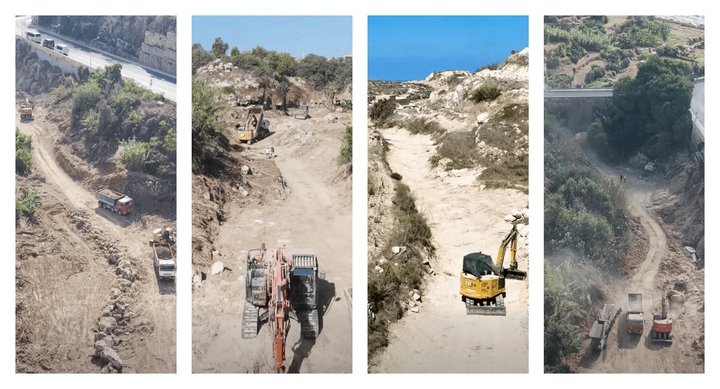
Photo PA: Artist impression of development