Be the first to comment!
“Hiding behind facades”: PA’s bid to convert building height limitations in Local Plans – Ghawdix
 Email item |  Print item |
|
Ghawdix has accused the Planning Authority of “hiding behind facades,” due to the fact that on the same day it “flaunted a circular meant to design facades for Gozo’s distinctiveness, another circular was issued delineating a process for converting building height limitations – previously specified in terms of the number of floors – into overall heights measured in metres.”
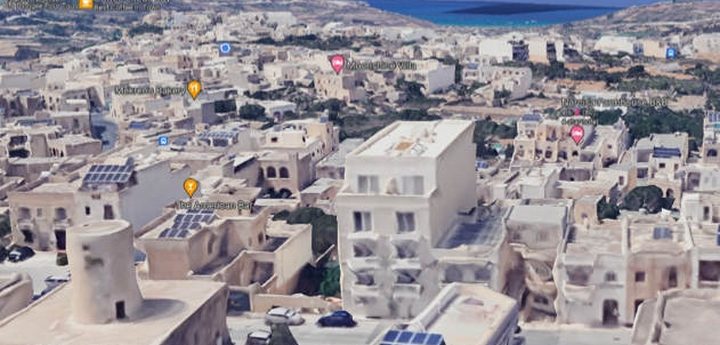
Ghawdix, in an example of how this can affect the skyline of Gozo, highlighted the above apartment block as seen in the photo. In January 2021 the PA approved this apartment block, “3 years later this block stands perched over the Nadur skyline,” it said.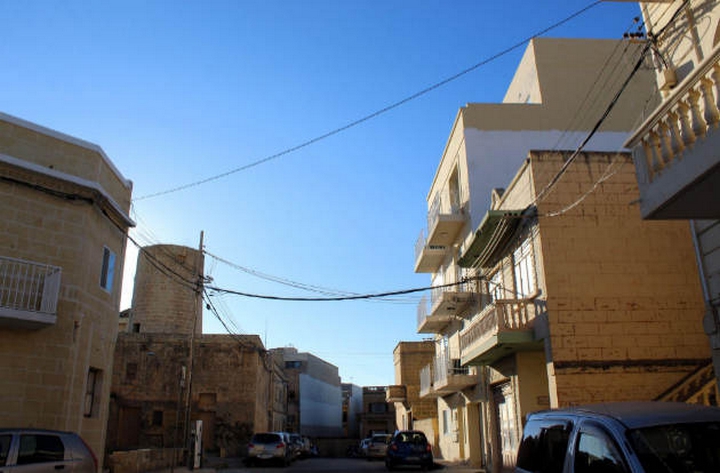 It noted that “even though the Local Plans only allows for 3 floors, the permit for 5 floors was still given, and this to the detriment of the streetscape, Nadur skyline and the 19th-century windmill opposite to the block of flats. This circular will now set this practice in stone, consequently allowing for more cramping of apartments,” stated Ghawdix.
The NGO explained that historically, Local Plans sanctioned between 1995 and 2006 contained constraints on building heights articulated as the maximum number of floors permissible for each urban block. Nevertheless, discrepancies in terminologies existed across different Local Plans.
It added that these plans were complemented by supplementary documents such as the Local Plans Interpretation Document of 2007 and more detailed Policy and Design Guidance issued in 2000 (DC2000), 2005 (DC05), and 2007 (DC07). While these documents provided interpretations and policy directives regarding building heights in metres, adherence to the allowable number of floors was emphasised.
It went to to say that in November 2015, a shift in approach occurred with the Development Control Design Policy Guidance and Standards, notably Policy P35, advocating for the regulation of building height in urban areas based on numerical dimensions of overall height and facade height measured in metres. Consequently, Annex 2, supporting Policy P35, was introduced to facilitate the conversion of building height limitations from the number of floors to overall heights in metres, entailing revisions to numeric dimensions for facade heights, supplanting previous Policy and Design Guidance from 2007.
Subsequent interpretations and applications of these guidelines by various development management institutions since 2015 were informally established through practice, said Ghawdix.
According to the NGO, this proposed circular 2/24 aims to formalise this conversion of building height from Local Plans approved between 1995 and 2006 into overall heights in metres, integrating these converted limitations into the Local Plans Interpretation Document as official guidance.
Ghawdix insisted that “this starkly contrasts with recent celebrations by the Ministry for Gozo and Planning regarding victories in preserving globigerina facades. Instead, it underscores a disregard for the primary concern: streetscape fragmentation due to pencil development, rendering arguments based on a net amount of floors obsolete and potentially exacerbating the issue by allowing for greater density within confined spaces.”
The NGO said that “unfortunately, a significant overhaul of local plans seems off the table, with authorities citing concerns of ‘great injustice’ and the protection of property rights.” It noted that Prime Minister Robert Abela, for instance, has argued against such revisions, asserting that they would cause ‘great injustice’ and stating that the government ‘cannot revoke people’s property rights.
Additionally in 2021, Ghawdix said that he told The Malta Independent that the local plans ‘created rights for property owners and it is not as simple as saying that the Government will change the local plan and the rights that these owners have…’ Similarly, the NGO said that the leader of the Opposition, Bernard Grech has given “conflicting information” during an interview on Times of Malta: at one point he emphasised the sanctity of existing property rights, stating that ‘we cannot touch the rights that already exist,’ while at another point he stated that, ‘we need to change the rules, we need to fix the rules, and we then need to enforce them…’
However, Ghawdix stated that “it is essential to recognise that in Malta, the right to develop ultimately rests with the State, not individual landowners, as explicitly outlined in the country’s Planning Act.”
“This fundamental principle underscores the responsibility of policymakers to prioritise sustainable development practices and the collective well-being of communities over individual interests. It highlights the imperative for policymakers to adopt a forward-thinking approach that fosters responsible development while preserving the essence of what makes Gozo truly special,” said Ghawdix.
It argued that “failure to address these pressing issues not only risks irreparable harm to Gozo’s architectural, cultural and historical treasures but also undermines the long-term prosperity and quality of life for its residents.”
Ghawdix concluded by calling on all interested parties to “act decisively to safeguard Gozo’s unique heritage and pristine landscapes for future generations, ensuring a harmonious balance between development and environmental conservation.”
Photos: Ghawdix