Be the first to comment!
Malta War Papers – Chronicles of courage in Malta and Gozo
 Email item Email item
|  Print item Print item
|
|
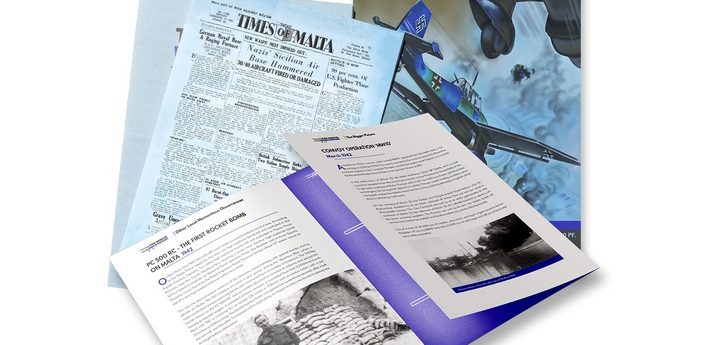
The terrible years succeeding the fateful day in 1939, which signalled the start of WW II, have been chronicled by Heritage Malta Publishing in The Malta War Papers – a 13-issue series commemorating 80 years since the end of World War II and the 50th anniversary of the National War Museum.
HM said that on Sunday, the 3rd of September 1939, the last local bus, which usually ran until 30 minutes before midnight, stopped at sunset. Places of public entertainment, which in summer closed their doors punctually at 1:00am, did not open. A feeling of dread and apprehension engulfed the Maltese gathered in churches for Sunday mass. Britain and France had declared war on Germany, and Malta – a Crown Colony – harboured no illusions of what could lie in store.
Heritage Malta noted that each edition focuses on key events during the war years and is accompanied by an iconic propaganda poster and a facsimile of a contemporaneous issue of the Times of Malta. From the Battle of the Grand Harbour to the award of the George Cross, the October Blitz, and the reconstruction of Malta, each issue highlights momentous occurrences in Malta during the war, as well as the war machines deployed for the defence of the island-fortress.
It added that some of the stories carried in The Malta War Papers are being reproduced here: As soon as Britain and France declared war on Germany, the Maltese population became concerned about whether Malta, serving as a fortress colony in the Mediterranean and guarding Britain’s trade routes to the East, would be dragged into the conflict. The immediate question on every Maltese person’s mind was how Italy would react. If Italy abided by its treaty with Germany, it would declare war on Great Britain, and half an hour later it could bombard Malta.
“The Maltese feared they might die like rats, fumigated by poison gas, blown to pieces by high explosives, or drowned at sea while trying to escape. Another fear was the possibility of a food shortage. Far from being self-sufficient, Malta depended entirely on other countries to stock its larder. Meanwhile, the Government assured the civilian population that there were enough supplies for six months.
“You’re wrong if you think that the ‘Keep Calm’ posters are a modern fad. They were actually motivational posters produced by the Government of the United Kingdom in 1939 in preparation for the war, intended to raise the morale of the British public,” said Heritage Malta.
The planning of the posters began in April 1939. Rough drafts of the posters were completed in July, and the final designs were approved by Home Secretary Samuel Hoare on 4th August. The ‘Keep Calm’ poster
Nearly 2,500,000 copies of the ‘Keep Calm and Carry On’ poster were printed between the 23rd of August and 3rd of September. It formed part of a trio of posters which also comprised the ones declaring ‘Your Courage, Your Cheerfulness, Your Resolution Will Bring Us Victory’ and ‘Freedom is in Peril: Defend it with all your Might’.
The remainder of the poster campaign was cancelled in October 1939, following criticism of its cost and effectiveness.
Heritage Malta said on New Year’s Day 1942, the Luftwaffe used rocket-assisted bombs for the first time. According to the Malta Police report for that day, one high-explosive bomb fell and exploded in Argotti Gardens, Floriana. Two other high-explosive bombs fell and exploded in Piazza Fosse, Floriana, near the Scouts Headquarters, severing a water main. Another high-explosive bomb fell but failed to explode on National Road, between Portes des Bombes and St Anne Square, Floriana. It was found by the Royal Engineers Bomb Disposal Section about 137 metres away, on top of a very high bastion, and was safely recovered.
This was the second known instance of the Germans experimenting with special bombs during attacks on Malta, said Heritage Malta. The first instance occurred a year earlier during the Illustrious Blitz, when a radio-controlled armour-piercing bomb was recovered from a nunnery in Cospicua.
Gozo’s role during the war years
Heritage Malta said that although Gozo did not suffer attacks during 1940 and 1941, blackouts, curfews, rationing, Victory Kitchens, and the black market were prevalent. Surrounded by sea mines, transport between Gozo and Malta was hindered, negatively affecting Gozo, which relied on Malta for provisions. Gozitans often reported sightings of Axis submarines in their waters, especially outside Dwejra’s Inland Sea. Gozo boats and ferryboats were frequently strafed. Hundreds of Maltese found refuge on the sister island.
It explained that during conscription in early 1941, about 600 Gozitans were called up for service, with many joining the K.O.M.R., R.M.A., and R.A.M.C. A radar station AMES 521 was installed in Gordan Lighthouse, and the Royal Navy had a unit in the same area. In June 1943, an Air Sea Rescue base was set up in Dwejra, and before the Allied invasion of Sicily, an airstrip was constructed in Xewkija by American engineers.
The Axis, knowing Gozo was practically defenceless, proposed invading the island to gain a foothold on the Maltese Islands and prevent Gozo from being used in a counterattack, said Heritage Malta. Several enemy aircraft crashed in Gozo, and the island experienced bombings and strafing by German bombers and fighters, resulting in civilian casualties. The most significant attack occurred on 10th October 1942, killing 16 civilians and injuring two. On the 6th of May 1942, German aircraft destroyed the Gozo ferryboat Royal Lady in Mgarr Harbour
In mid-June 1942, Heritage Malta said that Governor Lord Gort organised an emergency meeting to address Malta’s food shortage, with Mons. Michael Gonzi, Bishop of Gozo, present. The National Farmers Club, and especially Gorg Pisani and Kelinu Vella Haber, convinced Gozitan farmers to surrender wheat, collecting 2,400 tons. This effort was crucial in sustaining the collective war effort.
The last days of the war
Heritage Malta said that during the first months of 1945, the war worsened for the Axis. In Italy, the war was nearing its end. On 25th April 1945, Benito Mussolini and his mistress Claretta Petacci tried to escape into Switzerland but were recognised by partisans and shot the following morning with other leading Fascists. The Germans in Italy surrendered unconditionally on 29th April 1945.
On the same day Mussolini was captured, American and Soviet troops encircling Berlin joined forces as they prepared to attack the German capital, where Hitler had sought refuge in the Chancellery bunker, said Heritage Malta. As the Soviets closed in, Hitler appointed Grand Admiral Karl Donitz as his successor and shot himself on 30th April.
The war in Europe ended on 7th May 1945, when General Jodl, on behalf of the German General Staff, signed the unconditional surrender to the representatives of Britain, America, the Soviet Union, and France in Rheims, France. It was agreed that hostilities would cease at midnight on the 8th of May, said HM.
Malta, along with the rest of the free world, celebrated VE (Victory in Europe) Day. In Valletta, Maltese civilians, British and other Allied servicemen joined hands, marching down beflagged Kingsway with bands playing and church bells ringing.
Anyone wishing to acquire the complete set of the Malta War Papers, should please click here.
The Malta War Papers are based on research conducted by Charles Debono, former Curator and current Senior Researcher at the National War Museum, and author of ‘Malta during WWII.’
Photo: Heritage Malta – Contents of an issue of The Malta War Papers