 1 comment.
Vigil held in Munxar commemorates St Paul’s Shipwreck
 Email item Email item
|  Print item Print item
|
|
Hardly any other activity could have been more fitting to commemorate St. Paul’s shipwreck in Malta 1950 years ago, than the diocesan vigil held in the small village of Munxar last Tuesday, February the 9th. As the large pavilion, purposely set up for the occasion in the church square, swelled with the massive congregation which assembled from the all parts of Gozo, a roaring fire was lit up to replicate the scenario of nearly two millenia ago. Equally fitting was the biting cold and the on and off drizzle which complemented the landscape. With a big heart, the people of the parish, proud of their patron St. Paul, welcomed the visitors.
At 6.00pm His Lordship Bishop Mario Grech led over 60 concelebrating priests, including parish-priests and members of the various religious orders from the church to the packed canopy, and thus gave way to the solemn function. The highlights included the renewal of the baptisimal vows a symbolic light up from the fire and an ending cortege aux flambeaux which was rounded off by the Bishop’s blessing of the faithful with St. Paul’s reliquary. Additionally, there was Mgr. Grech’s inspiring sermon for the occasion of which the following is a summary.
St. Paul’s shipwreck among us is a key defining moment in the history of our people; not only in the religious sense but in the emergence of the nation. Equally significant as the salient moments of our story – Independence, Republic, Freedom Day and EU membership – St. Paul’s passage has been no less crucial. The Biblical overtones of Luke’s narrative in the Acts of the Apostles hark to another vital passage in the story of another people; God’s chosen people of whose unconfined territory we are now part, thanks to Paul.
The fourteenth day and night in the Acts parallel the fourteenth day of the month in Exodus when the People of God were liberated from their bondage in Egypt and set on their journey towards the promised land from the night of the Passover to Easter freedom. Likewise, on the fourteenth night, St. Paul’s shipwreck provided the Lord’s Passover on our islands, the blood of the Divine Lamb replacing that of sheep and goats. The conversion trail endures as we are summoned to replicate it in our lives to relocate the passage of old from a pagan to a Christian culture.
The Acts of the Apostles describes the tempestuous seas which engulfed Paul and the crew. The roaring seas are a symbol of darkness chaos and death inhabited by the leviathan and similar animalic forces which threaten human existence. On a similar boat are we now afloat, but Paul is still there to ensure the safe passage of Christ’s Church across the billowing seas.
To recall the pre-exodus hardship, the people of God ate unleavened bread for seven days, afterwhich they prepared the new dough of their renewal. In analogous fashion Paul invokes his companions, first to eat their bread and then to throw the old dough to the sea, to shed off their old clothes and put on the new. Through Paul, the Maltese had to come to terms with the new values of the Gospel in direct contrast with their habbit-ridden and arid traditions. Today, Paul beckons still; Get rid of the old dough and rejoice because our sacrificial Easter lamb, Christ, has been immolated. Be the new unleavened bread of integrity and purity.
Just as God gave the commandment tablets to His people, so did Paul give us the new code of the Good News. This is the Pauline passage which led the people of God in our country to freedom. But is this passage, repeated in the fording of baptism, still relevant today? Formally our names feature in the parish Baptism registers; but do our social structures still reflect Christian values which we have every right to demand? As baptized Christians we are duty bound to live this profound human and spiritual experience and exhort others to the share in it.
With Paul’s arrival a transformation occurred. Oblivious as we were to the true God and to Christ, we became aware that Jesus Christ, the Son of God assumed human nature to make us aware of our humanity. While we respect the positive lay characteristic of our society, it is unadvisable to detach ourselves from God; otherwise we would be reversing the passage achieved on the strength of Paul’s shipwreck from a believing society to a Godless one.
The wonders of Passover night were transmitted from generation to another by means of the young. Even tonight many families have brought their children here; but why come to Munxar on such a cold evening? Parents should feel proud that today, on this night we are here together to commemorate Malta’s passage to a new life in Christ. The family is the primary agent for the transmission of these values and if it fails to bequeath the Gospel patrimony to its children, others are likely to fill their minds with rubbish.
Today we need a new Moses and Paul is our new Moses who has led us from bondage to the freedom of being God’s children. In the physical sense, Paul is no longer with us; but in a short time we would be welcoming Pope Benedict XVI on our shores. Peter’s successor is the new Moses whose presence among us will help us set our compass in the right direction. Let us prepare ourselves so that this event will revitalise that passage which our people achieved 1950 year ago with St. Paul’s shipwreck.
Alfred Grech










An uplifting occasion, though possibly a little too long?!
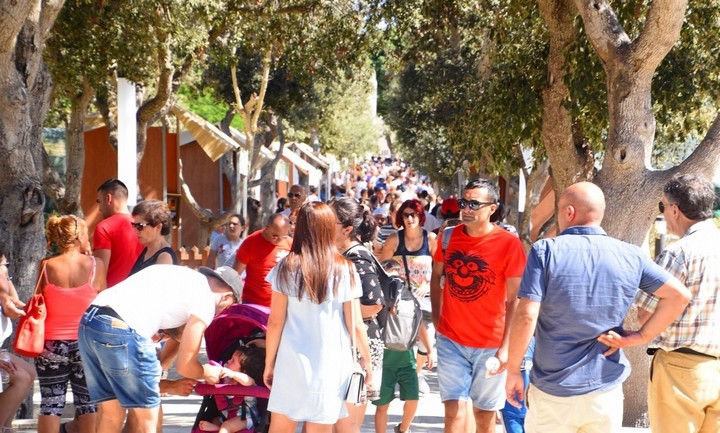
The congregation included a good cross section of Gozo’s clergy, religious and laity.
May St Paul encourage us to be witnesses in public whenever and wherever attempts are made to give Truth the cold shoulder!