Be the first to comment!
BirdLife welcomes EU Commission’s 2nd warning against Malta’s ”false” finch research derogation
 Email item |  Print item |
|
 BirdLife Malta has welcomed last Thursday’s European Commission’s decision to issue a reasoned opinion against Malta over its continued authorisation of finch trapping under the guise of scientific research. ”Although this step has come later than we would have wished, it is neither surprising nor unexpected,” it said.
It confirms what BirdLife Malta has documented for years: Malta’s so-called finch research derogation is recreational trapping disguised as science. In its reasoned opinion of 19 November 2026, the Commission maintains that Malta’s derogation does not pursue a genuine research purpose but allows recreational trapping to continue.
The organisation said that the warning is the second one following a previous one sent in November 2025 last year, which had clearly warned the Maltese government that the finch ‘research’ derogation was in breach of not only the Birds Directive but also of the two European Court of Justice judgements in 2018 and 2024.
It added that ”it also highlights Malta’s failure to demonstrate that no other satisfactory solutions exist and that Malta’s 2025 legislative amendments weakened enforcement provisions and reduced the involvement of qualified bird-ringing scientists. These are fundamental failures, not technicalities.”
BirdLife Malta said that ”despite the impending escalation of infringement proceedings, the Maltese government has this year still decided to re-open a finch ‘research’ season, aggravating further the fundamental failures of enforcement by permitting an increase in the number of licensed trappers and consequently an increase in the number of trapping sites.”
Finch trapping sites in 2026 have increased to a total of 3,688 sites compared to 2,932 sites permitted in 2025, as a result of an increase in the number of licensed trappers permitted to catch finches, the organisation said.
”The increase in trapping licenses has for the second time overthrown a moratorium on new trapping licenses initially agreed with the European Commission as part of Malta’s accession treaty,” said BirdLife. ”As a result the catch effort of Maltese trappers on European finches migrating this autumn has increased by over 25%, resulting in further mortality of these protected species.”
BirdLife Malta also noted FKNK’s latest statement questioning what could motivate the Commission to challenge what it calls scientific research or ”citizen science.” The answer is simple, said BirdLife: ”this is not genuine scientific research. Citizen science can make an important contribution when it follows credible methods and generates reliable findings. Involving thousands of people in an activity does not, by itself, make that activity scientific.”
It went on to say that ”if FKNK believes successive seasons of finch trapping constitute research, we challenge it and the authorities to publish the results. Where are the findings and the knowledge generated? At the very least, they should release the collected data, a clear summary of the main findings, the methodology used and the conclusions drawn. After years of trapping, the public deserves answers rather than repeated assertions that science is being conducted.”
The organisation said that the 2026 derogation authorises trapping for 62 days, from 20 October to 20 December, across 3,688 registered trapping sites. ”Even an abundance of data would not automatically legitimise an unlawful or disproportionate activity.”
”The stress and disturbance caused to wild birds, the impact on habitats and the occupation of large areas of countryside cannot be dismissed. People should be free to enjoy countryside walks and appreciate wildlife without widespread trapping intruding on that experience. Our countryside belongs to everyone, not only to trappers,” insisted the organisation.
BirdLife Malta said that it has repeatedly documented abuses under the cover of this supposed research derogation. ”These include the illegal smuggling of finches from Italy to provide live decoys, unattended trapping nets and, more seriously, captured finches being retained rather than released as required.”
”Our field investigations have shown birds being caught and kept for personal enjoyment instead of being released after the purported collection of scientific information. These concerns have been reported to the authorities and the European Commission over successive seasons,” it said.
”The reality on the ground bears little resemblance to carefully supervised research,” stated BirdLife. ”The derogation instead creates opportunities for recreational trapping to continue under a scientific label. The Commission has seen through this deception. FKNK’s references to traditions elsewhere in Europe do not answer the legal and scientific objections to Malta’s arrangements: cultural heritage cannot turn recreational trapping into research or excuse non- compliance with the Birds Directive.”
BirdLife Malta concluded by calling ”for the immediate withdrawal of the finch-trapping derogation and full compliance with EU law. If Malta fails to remedy the shortcomings within the two-month deadline, the European Commission should take the necessary legal action.”
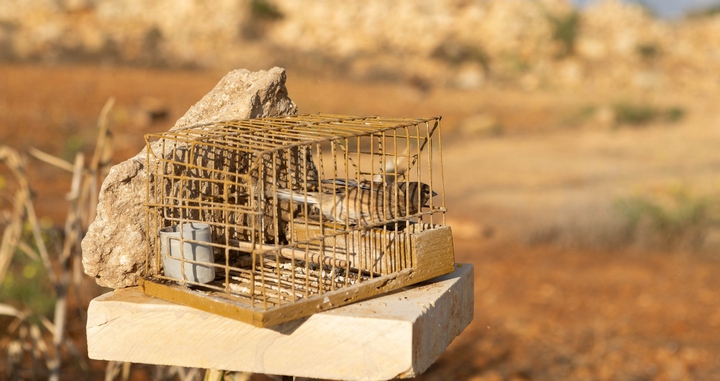
Photo BM: Common Linnet in a cage to serve as a live decoy at a trapping site by Luca Eberle