 1 comment.
FKNK critical of the Draft National Environment Policy
 Email item Email item
|  Print item Print item
|
|
 The Federation for Hunting & Conservation – Malta (FKNK), has said in a statement that it “considers the draft National Environment Policy (NEP) as replete with generalisations and grey areas which are open to interpretation, and lacking directness and transparency.”
“In particular,” the FKNK said, “it regards the insertion of the term “Status of farmland birds” as an attempt to further undermine the hunting and trapping traditions. The term has never been used before in a Maltese context, and has never featured in any major Maltese publication about birds. Any decision on ‘farmland birds’ is bound to affect the majority of the migratory birds that may legally be hunted/trapped in Malta, since they could all fit loosely within the category. The FKNK insists, therefore, on the removal of all references to so-called ‘farmland’ birds.”
“The FKNK concluded that:
1. For the sake of justice and transparency, the NEP should clarify grey areas open to interpretation that may impact hunters/trappers such as land management, changes to private property rights, and creation of public footpaths.
2. It is absolutely unacceptable that the NEP enables the government to decide unilaterally on the hunting/trapping of “farmland birds” migrating over the Maltese islands. Therefore, the FKNK expects the corresponding references to be removed.
3. It is equally unacceptable that the Policy makes it possible for the government to make unilateral decisions to limit/ban hunting/trapping based on an arbitrary evaluation of over- exploitation of species.
4. In order to live up to its declared aims, the NEP should state clearly and without equivocation that binding decisions on major issues will not be put into effect without the full agreement of all the stakeholders.”
FKNK’s Full Critique can be viewed on the link here.





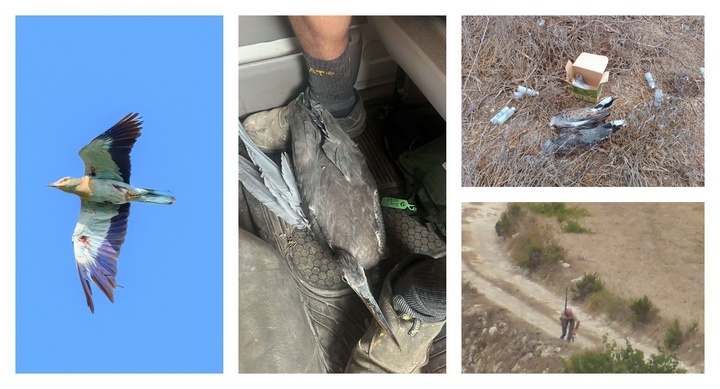




These people are not hunters how can you be called a hunter when all you shoot are poor defenceless song birds or protected birds who can not fire back. It is not as they have to shoot them to feed them selves or are to poor to buy food.