 4 comments so far.
Rare bird shot down in Gozo sent to Sicily for rehabilitation
 Email item Email item
|  Print item Print item
|
|
A Pallid Harrier, one of Europe’s rarest birds, is this evening being sent to a wildlife rehabilitation centre in Sicily after it was shot in Gozo on the 8th September, Birdlife Malta said this afternoon.
The Pallid Harrier (Circus macrourus) is a rare visitor to Malta and is considered to be one of the most threatened birds of prey in Europe (1). BLM said that the juvenile Pallid Harrier was seen being shot by a member of the public in Gozo who gave the injured bird to BirdLife. A veterinary surgeon examined the protected bird and diagnosed a fracture to its right wing.
“Luckily, the injury was not fatal and with proper treatment this bird is expected to make a full recovery. Malta to date does not have the rehabilitation facilities to care for wild birds with these kinds of injuries,” said Nicholas Barbara, BirdLife Malta Conservation Manager.
The Pallid Harrier is being sent to the Centro Recupero Fauna Selvatica, a wildlife rehabilitation centre in Sicily, which has successfully rehabilitated various shot birds that were sent over by BirdLife Malta in the past.
Last year, BirdLife sent another injured Pallid Harrier to a centre in Berlin. The bird, which had been shot during the spring hunting season of 2011, had suffered a fracture to its left wing, but was unable to recover flight and had to be euthanised.
Birdlife Malta said that “since the opening of the hunting season two and a half weeks ago, BirdLife has received 10 shot protected species. Most of them had fatal injuries and had to be euthanised by a veterinary.”
“The number of shot birds received by BirdLife Malta is just a small indicator of the vast scale of illegal hunting going on in Malta. Yet Malta has no wildlife crime unit or a proper rehab centre for injured animals. We expect the government to consider Malta’s wildlife as one of its assets and therefore one of the country’s priorities in the next budget,” concluded Mr Barbara.
BirdLife Malta said that it “encourages members of the public to report illegal hunting incidents to the ALE. Hunting after 3pm is illegal between 15th and 30th September, a ban enacted to protect migrating birds of prey. Instructions on how to file a report can be found at www.birdlifemalta.org.”
Notes:(1) “This species is known to be undergoing steep population decline in Europe, although numbers in its Asiatic strongholds are thought to be more stable. Thus it is probably experiencing a moderately rapid population decline overall, and consequently it is categorised as Near Threatened.”
Citation: BirdLife International (2012) Species factsheet: Circus macrourus. Downloaded from http://www.birdlife.org/datazone/speciesfactsheet.php?id=3409 on 18/09/2012.
Pallid Harrier shot in Gozo sent to Sicily for rehabilitation http://www.youtube.com/watch?v=LrrvLCsx_-o&list=PLPsgxrjyvsxbkS-IiMa9bXvKwvo0zjfFj&index=4&feature=plcp.
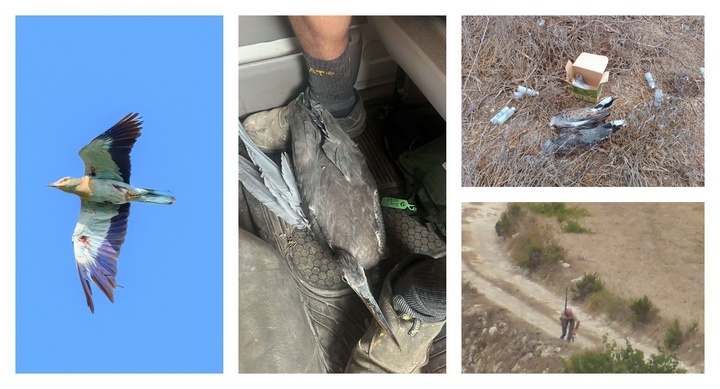
Photos show “One of Europe’s most threatened birds, this juvenile Pallid Harrier was shot in Gozo on its first migration after hatching this year,” – Birdlife Malta.














i hope the a**hole responsible for shooting it was caught, what perverted pleasure do they derive from this..
Is there any information on what happened (or not) to the shooter?
It is sad reflection on the entire population of Malta & Gozo when a large number of people can consider the shooting of migratory birds acceptable. If this was hunting for the pot it might be understandable or if these predators were threatening local livestock then may be it could be justified but this is killing for no other reason than target practice.
Unfortunately until the holding of firearms is more strictly limited and the illegal use of fire arms punished then this will continue to the detriment of the environment, and the decimation of beautiful species that belong to the world not the Maltese.
What sort of message does it give to our children?
So it starts over again. Sick, sick, sick individuals. The sad thing is the hunters do have children and they pass their sickness on to the next generation.