Be the first to comment!
National Literacy Strategy launched for All Framework
 Email item Email item
|  Print item Print item
|
|
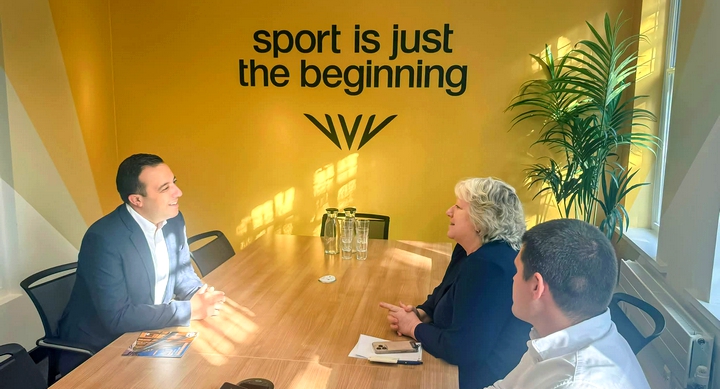
 The Minister for Education and Employment, Evarist Bartolo, has launched a National Literacy Strategy for All Framework this morning. The Framework is intended to serve as a basis for intensive consultation with stakeholders, on the basis of which, a National Literacy Strategy for All will be formulated in the coming weeks.
Minister Bartolo has announced the setting up of a number of working groups which are tasked with fleshing out the different aspects of the National Literacy Strategy Framework in the coming weeks. This should lead to the formulation of a National Literacy Strategy for All following wide-ranging consultation.
The Minister added that interested entities and the general public are invited to submit their feedback on the email address: literacy.mede@gov.mt
“It is the intention of the Maltese government to do its utmost to ensure that every one in Malta is provided with the best opportunities to acquire the required literacy skills. This goal will be achieved through a National Literacy Strategy for All and a complementary National Literacy Campaign which will target different sectors of society.
“This will be implemented also in the light of recent results obtained by Malta in the Programme for International Assessment (PISA) 2010 where the percentage (36.3) of 15 year-olds who were low achievers in reading literacy was significantly higher than the EU average (19.7) and in the Progress in International Reading Literacy Study (PIRLS) 2011 where the mean reading score (477) of Maltese ten year-olds was significantly lower than the international average.”
The overriding principles of the Framework
In Europe the phenomenon of children who go through the statutory years of schooling without obtaining the basic skills which allow them to move ahead is increasing. There is also concern about the long-term benefits of intervention programmes and what can be done to ensure that there is not a fade out of effects.
How do we structure programmes that produce lasting effects? The goal in educational intervention is to have lasting effects. Empirical evidence points to the need for comprehensive interventions that span multiple years and target key transition points as crucial elements of programmes addressing children’s learning needs.
There is a need to reduce the fragmentation of educational services and literacy programmes. We need to integrate better our strategies and the services being offered in order to achieve a better sense of continuity. The literacy programmes on offer are to be an integral part of or complement the educational programmes in schools.
The National Literacy Strategy for All will propose a number of measures, for implementation with diverse groups of Maltese society, which should have profound and long-lasting effects. The current literacy programmes are to be consolidated and extended further in order to ensure increased effectiveness and value added. A number of new measures which will affect different strands of Maltese society will be proposed. For the National Literacy Strategy for all to be a success the commitment of government, various ministries, departments and other agencies is required. There is also a need for the involvement of different groups of Maltese society and of every individual. The Minister explained that personalities will serve as ‘reading ambassadors’ in a drive to motivate more children to read.
In order to reach everybody the National Literacy Strategy for All will feature elements of both lifelong and lifewide education. It will also place emphasis on aspects of intergenerational education as espoused by UNESCO. This is because of the strong relationship which exists between the levels of literacy of children and of those who care for them. This should lead to a better integration of the educational programmes offered by schools and those offered by other agencies for children, parents and other adults.
School-initiated and school-based programmes
Teachers, heads of schools and principals are to be empowered to plan and implement their own projects to provide literacy support to individual students who may require it. This is to be achieved through the award of grants for projects proposed by schools
The Structure of the National Literacy Strategy for All
The National Literacy Strategy for All will describe the various strategies employed throughout the Maltese formal and non-formal educational systems and beyond to enable children, young people and adults to acquire the necessary literacy skills.
Children and young people are expected to become accomplished in:
– oracy across the curriculum – reading across the curriculum – writing across the curriculum
The focus of the National Literacy Strategy for All will be on the learners’ acquisition of and ability to apply the skills and concepts they have learned to complete realistic tasks appropriate for their stage of development.
The National Literacy Strategy for All will seek to make explicit the various measures and strategies employed at different levels and across a number of situations. This should allow for better coordination and integration of strategies to ensure increased effectiveness.
Bilingual Policy
One of the essential elements of a bilingual country is the ability to move easily between languages and become fully bilingual. This capability is valuable because it allows people in Malta, wherever possible, access to both Maltese and English and other languages. It enables access to a wide and varied linguistic heritage and provides learners in Malta with a head start in literacy skills that can be further developed and applied to European and world languages.
The National Literacy Strategy for All will focus on the range of literacy skills required to ensure competence in Maltese and English. In order to develop dual literacy skills where learners can move freely between the Maltese and English languages, learners need to be given specific learning opportunities that will help to ensure proficiency in both languages.
These opportunities should involve providing learners with access to learning materials in both languages with meaningful tasks and within a range of subject-specific contexts as appropriate. The National Literacy Strategy for All will support dual literacy and seek to ensure that it is fully embedded within the education system in Malta.