Be the first to comment!
Spot the Jellyfish campaign celebrates its 10th anniversary this June
 Email item Email item
|  Print item Print item
|
|
 This June, the Spot the Jellyfish citizen science campaign will be celebrating its 10th anniversary.
The campaign was started by Prof. Aldo Drago as a joint initiative between the Physical Oceanography Research Group within the Department of Geosciences and the International Ocean Institute (IOI).
The campaign has received thousands of jellyfish reports from the public, all of which have been validated along technical grounds and published spatially online on the campaign’s website.
The Spot the Jellyfish campaign is currently coordinated by Prof. Alan Deidun, with the support of Dr Adam Gauci, Mr Martin Galea Degiovanni, Dr Joel Azzopardi and Mr Johann Galdies.
All validated submitted reports can be viewed online on a summary map which depicts jellyfish occurrence and distribution on a spatial and temporal scale.
The University of Malta explained that this makes the campaign the longest continuous-running national jellyfish spotting campaign within the entire Mediterranean Basin, representing a priceless example of a national marine monitoring platform.
Since the inception of the Spot the Jellyfish campaign, the public submitted thousands of jellyfish reports, which are being assessed from a scientific/technical perspective so as identify trends and links with environmental parameters and are also being plotted on map of the Maltese Islands for the benefit of all sea users.
UM said that nine new jellyfish species, previously unknown from Maltese waters, including alien species such as the nomadic jellyfish and Australian spotted jellyfish, as well as other non-alien species such as the crystal jellyfish and the compass jellyfish, have been recorded since the start of the same campaign, bringing the total number of gelatinous species known from Maltese waters to date to over 40.
More importantly, from an ocean literacy point of view, the Spot the Jellyfish has managed to inspire countless schoolchildren (through school visits), stakeholders (e.g. beach life guards, boat owners) and members of the public in general through its continuous outreach campaign.
Reporting is done through the website by simply matching the sighted jellyfish with a simple visual identification guide (just click on the jellyfish banner), giving the date and time of the sighting, and indicating the number of individuals seen. Sightings can be reported online, or by sending an email.
In recent weeks, the Spot the Jellyfish team said that it has been receiving numerous reports of jellyfish species from locals and visitors alike.
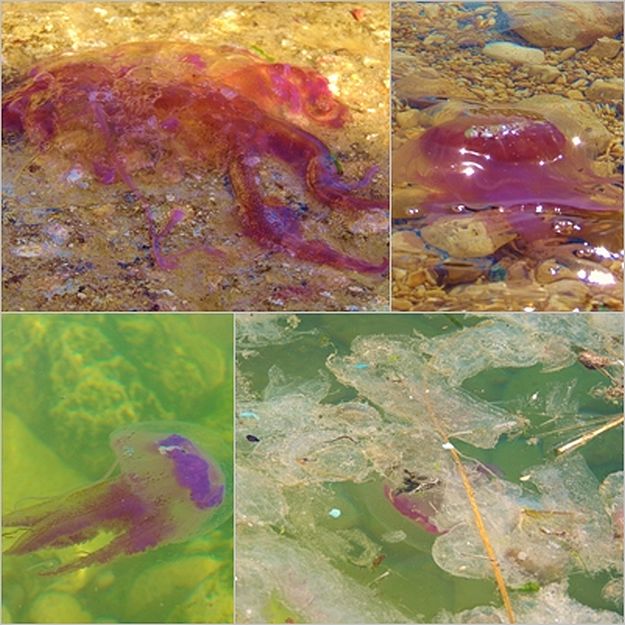
Especially noticeable have been the reports on the current mauve stinger (scientific name: Pelagia noctiluca) bloom, which has been reported to the Spot the Jellyfish team over the past few days by several members of the public along several stretches of the coast of Malta and Gozo, especially in south-eastern and eastern swathes of the coastline, where persistent south-easterly winds have resulted in a massive beaching of thousands of mature mauve stinger individuals.
Blooms for this species are typical for this time of year in the Central Mediterranean, normally commencing towards late autumn in the warmer waters off north Africa, making their appearance further north in Maltese waters towards mid-winter (late January and early February).
At this time of year, in fact, mature mauve stingers rise to the upper waters from deeper ones to reproduce, before dying en masse.
This bloom coincides with the annual phytoplankton bloom which is witnessed in the central Mediterranean at this time of year, with the new generation of ephyrae (miniature jellyfish) making their appearance in a few months’ time (mid-spring).
The mauve stinger has been observed in the Mediterranean at least since 1785, but outbreaks of the species have become more frequent only since 1999. In fact, until 1998, mauve stinger blooms occurred every 12 years and had an average duration of 4 years – since they, they have become more common, presumably as a result of the stressed status of the Mediterranean, presumably due to climate change, overfishing and coastal urbanisation and discharges.
The team said that also being spotted in significant numbers this winter are the comb jellies (scientific name: Ctenophora). “These fascinating creatures have also arrived to our upper sunlit waters to feed on the planktonic blooms typical for this time of year; and unlike the unrelated mauve stingers, these gentle animals do not sting or harm humans.”
In fact, some of these comb jellies have the rare and fascinating ability to be able to emit their own light, and often delight divers with their underwater sparkles. The by-the-wind sailor will soon make its first appearance in local waters, as this species is normally expected to appear in early spring.
The campaign is supported by the Malta Tourism Authority (MTA), Nature Trust (Malta), the EkoSkola network, Blue-Flag, Friends of the Earth and Sharklab, with the MTA sponsoring the design and deployment of the campaign’s trademark seaside panels.
Following the success of the Spot the Jellyfish campaign, the same research group, still with the support of the IOI, has initiated in 2017 two other citizen science campaigns on a national basis, the Spot the Alien and the Spot the Alien Fish campaigns, in order to assist national monitoring efforts in relation to marine NIS (Non-Indigenous Species).
File Photographs by Alain Salvary – Mauve stinger jellyfish bloom Xlendi