Be the first to comment!
Moviment Graffitti unveils document on planning and construction reform
 Email item |  Print item |
|
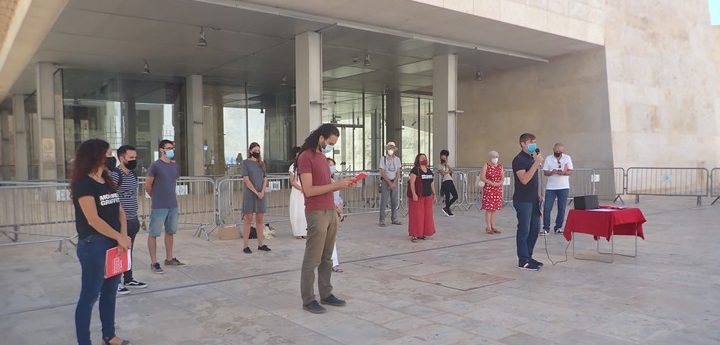
Moviment Graffitti has unveiled a set of wide-ranging proposals aimed at reforming the planning and construction sector and beyond.
Activists are also seeking a meeting with the Prime Minister and Ministers, to put an end to abuse and improve quality of life of residents.
The activist group has today launched – Reforming Planning and Construction in Malta -a document with 134 proposals split over six distinct sectors, created after a year of technical consultation and with the input of various groups and individuals.
The document comes a year after the Iz-Zejjed Kollu Zejjed (“Enough is Enough”) protest of the 7th September 2019, and in the wake of a spate of construction-related accidents including the death of Miriam Pace in her own home earlier this year as well as the rapidly deteriorating state of our natural environment and our urban spaces.
The activists explained that the six main domains of this reform document are planning policies, the authorities responsible for planning and the environment, large-scale projects, the regulation of the construction industry, roads and transportation, and respect for the country and its ecosystem.
Among the key demands, the first chapter requests the introduction of a new policy that replaces SPED and which has a long-term view up to 2050 in line with the UN’s Sustainable Development Goals.
The chapter regarding policies also demands better protection of UCA’s, with a focus on removing the loopholes in various policies (FAR, SPED, Rural Policy) and offering better protection to buildings of historical and cultural importance.
When it comes to the authorities, the activists said that the document advocates a radical overhaul of the way PA board and commission members are chosen, with the introduction of parliamentary grillings for their members, and a parliamentary vote on a number of board and commission members.
It stressed that “under the proposed reform, members should be held personally responsible for their conduct, especially in terms of breaching policies, their own code of ethics, conflict of interest, undue influence and other improper behaviour.”
Moviment Graffitti said that “another bone of contention between residents and developers is that of large-scale projects.”
Among others it is being proposed that Local Councils affected by major private projects falling under Schedule 1 are given the power to impose a condition that a development must be approved by a local referendum which is to be held within 30 days of the permit’s approval, it said.
The document also recommends a moratorium on large-scale projects until both national and localised Masterplans are enacted.
Moviment Graffitti explained that some of the most salient proposals are found in the fourth chapter, related to the regulation of the Construction Industry.
A key proposal, activists said, is the introduction of a measure by which legal, psychological and logistical support to residents stricken by construction accidents is paid for from a fund populated by mandatory fees from developers, until responsibility is legally established.
“Other proposals include a limit on the number of concurrent permits issued in a set area or neighbourhood, the creation of a public complaints system, linked to a penalty points system, so that contractors or developers repeatedly falling foul of the law are publicly blacklisted, and a legal framework which brings together all building and construction regulations within one Act,” activists said.
There are also provisions related to construction workers and their protection, especially considering the “lax health and safety situation in this particular industry,” the added.
As for roads and transportation, the main drive is for the introduction of an efficient and free public transport system, with shorter, better and more frequent routes instead of a public service that aims to operate for profit. Incentives for bicycle use and the creation of safe bike lanes also feature in this section.
Another demand is to repeal the system whereby Infrastructure Malta can asphalt and widen country lanes without following the full planning application process.
In the sixth chapter, issues such as waste, the recycling of construction material, land reclamation, and solar rights are tackled, but also the hot issue of public land being transferred to private interests, where Moviment Graffitti are demanding an immediate halt to such land transfers and the creation of more public spaces.
“This document is the fruit of a year of consultation with key experts and NGOs,” said a spokesperson for Moviment Graffitti.
“We have had a tragic year in construction and our quality of life is steadily deteriorating due to a rotten planning system. The authorities can no longer sit idly by as if nothing were happening. Moreover, we feel the business lobby’s hegemony over politics has stifled reforms for too long.”
“We intend to present these proposals to the Prime Minister, the Environment Minister and the Transport Minister, with a view of improving the quality of life of many residents affected by continuous construction. We believe their reaction to these proposals is to be interpreted as a message of their willingness to improve the situation,” said the spokesperson.
Reforming Construction and Planning in Malta is available for free to download here and is endorsed by 23 groups.