Be the first to comment!
Trapping for 7 species of songbirds opens “under strictly supervised conditions”
 Email item Email item
|  Print item Print item
|
|
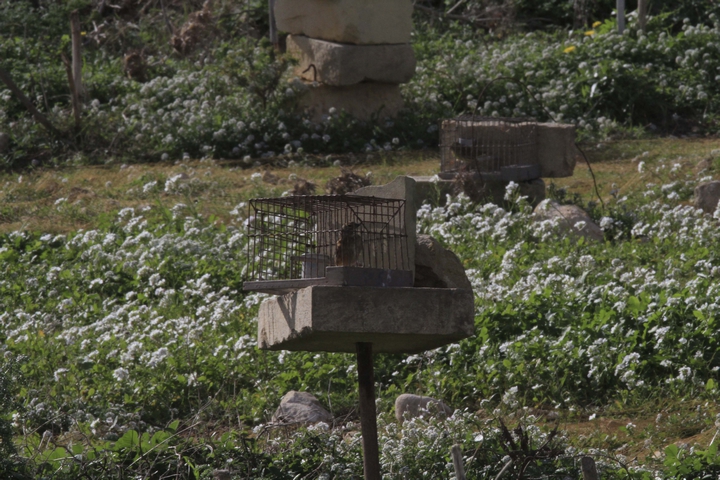 The Gozo Ministry, which is also responsible for hunting and trapping, has announced the opening today of the trapping season for seven species of songbirds, “under strictly supervised conditions.”
In September, the Court of Justice of the European Union gave judgement that “by adopting a derogation scheme allowing the live capturing of seven species of wild finches, Malta has failed to observe its obligations under EU law.” This judgement was disputed by the Ministry for Gozo and Planning, which said that “it remained committed to the cause.”
The Ministry said in response to the judgement that it “remains resolute in defending the lawful practices of hunters and trappers and will continue to engage with all relevant stakeholders to ensure their concerns are appropriately addressed, in full respect of EU law and this judgement.”
In a statement, the Ministry said that “the Government’s work to continue defending the Songbird Research Project yielded a positive result as on the 19th of September, the European Court of Justice decided on just one point from list of alleged violations that the European Commission had brought against Malta in Case C-23/23.”
The Ministry said that the ECJ “based its decision on the content of the Legal Notices of 2020, 2021 and 2022 where it found that they did not include a statement and justification regarding the lack of another satisfactory solution. The European Court of Justice did not take any position on the other points mentioned by the European Commission, except that the Regulatory Framework (L.S.549.145) is clear and precise.”
“After the analysis of the ECJ decision, the Government undertook to ensure that the Legal Notice declaring a research period in autumn 2024 includes a statement and justification confirming that there is no another satisfactory solution to collect information on where the songbirds come from during the fall migration, except through the Research Project,” the Ministry said.
It explained that this is “where the trapper captures the songbirds using traps, checks they have a scientific ring, writes the details on the rings form, releases them all from the same place, and reports them through the free phone system. The special license also encourages the trapper to send short videos showing the release of the songbirds from the same place.”
The Ministry went on to say that the statement in the 2024 Legal Notice includes seven reasons that confirm and justify the lack of another satisfactory solution to answer the Research Project’s question: “Where do the songbirds come from that migrate across Malta in the autumn after the breeding period?”
The Ministry for Gozo detailed the seven reasons as follows:
1. The Research Project is based on a study of seven migratory songbird species and therefore requires a different methodology than a study on non-migratory birds.
2. Ornithologists and bird-ringers have not managed to collect, through the use of traps, the necessary information to achieve the stated objective of the Research Project.
3. The success of the Songbird Research Project does not depend on the participation of ornithologists, as shown by the number of foreign ring recoveries that have been recorded by licensed data collectors, without the collaboration of ornithologists, during the songbird research periods in autumn 2020-2023.
4. The bird-ringers do not use lures and decoys, which shouting are the main component of the trapping system that “allows a more selective capture of birds than mist nets.”
5. Bird censuses are designed to monitor population size and status, including changes in populations during the breeding period and during the winter and therefore cannot provide the knowledge of where the migrating birds come from.
6. It is not possible for migration studies to determine which migratory birds are equipped with a scientific ring and which are not, and it is likewise impossible to record the details of such rings, unless specimens from the relevant species are caught and physically examined.
7. The lack of information on songbird ring recoveries, together with unpredictable and complex factors, including weather, among many others, makes large-scale population modelling inadequate to determine the ecology of the songbird migration and therefore inadequate to determine the population of the regions from which the largest number of songbirds come before passing through Malta.
Therefore, the Government, after considering the Ornis Committee’s recommendation, is announcing the opening of the research period on the seven songbird species from today, the 20th of October, until the 20th of December 2024, both dates inclusive, the Ministry for Gozo said.
It stressed that anyone who participates in the songbird research project, under the authorisation of the special license issued in their name will be:
• Obliged to release back into the wild any songbird that they catch immediately after checking if it is wearing a scientific ring and report it at the same time (species and amount) by calling, free of charge, on 8000 2020 from a mobile number registered in their name, or by using the Game Reporting MT mobile app. The systems confirm the report by sending back an SMS as confirmation;
• Obliged to write all the details om the ring form issued in their name, which is included with the special license, if they catch a songbird with a scientific ring;
• Any bird caught that has a scientific ring must also be reported on the day as explained in the special license.
The are also encouraged to take a short video showing the songbirds being released from the same place where they were caught as explained in the special license;
• They report the research effort whenever they take part in the research project even if no songbirds have been caught, before leaving, by calling, free of charge, on 8000 2020 from a mobile number registered in their name, or by using the Game Reporting MT mobile app, as explained in the special license.
The Ministry concluded by saying that “anyone who is in possession of the special license for songbird research is legally obliged to observe all the regulations related to this derogation.”
Photo: Finch used as live decoy during the trapping season (Photo by Ben Metzger)