Be the first to comment!
Victoria Lyceum: Should respect architectural integrity – Coalition for Gozo
 Email item Email item
|  Print item Print item
|
|
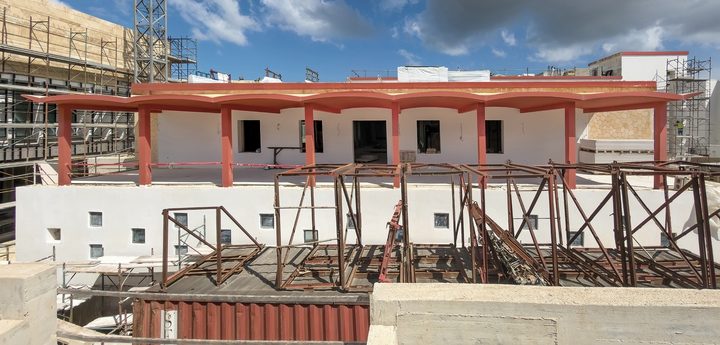
The Coalition for Gozo said that it ”notes with concern the recent re-painting in red of the cantilevered-entrance canopy and supporting pilotis (columns) of the Victoria Lyceum.
The Coalition, in a statement on Tuesday, said that the projecting canopy, pilotis and facade were conceived as a ”coherent whole, relying on proportion, rhythm, and the subtle play of light and shadow. Photographs from the 1960s onwards consistently show the building, designed by the Maltese architect Joseph G. Huntingford (1926-1994), as a unified white composition.”
White was not incidental., the Coalition said. ”it was integral to the building’s architectural language. Given that the architects of modernity were in search of purity of form, it stands to reason that the image of modern architecture is almost inevitably rendered in white in the collective imagination. Relieved of superfluous decorations, modern architecture became associated with the predominant use of white surfaces to highlight the volumetric composition.”
The Coalition stressed that ”a review of photographs spanning more than six decades reveals no instance in which the canopy appears in red.”
”This continuous visual record deserves serious weight. It has been stated that traces of red were found beneath later white paint layers during the recent works. While this is of interest, it does not in itself prove that red was intended as the final visible finish,” the Coalition said. ”It is equally possible that this layer formed part of an earlier preparatory treatment, such as a primer or undercoat covering the concrete canopy.”
It added that ”in the absence of photographic or documentary evidence showing the entrance overhang in red, that possibility cannot be ignored.” The Coalition stated that ”from the photographic evidence, it is clear that Huntingford had originally conceived the canopy together with the supporting pilotis to be in white. At a later stage, the front edge trimming appears to have been painted red. Even so, this too was originally white and formed part of the building’s unified architectural composition.”
Nor was this an isolated feature in Huntingford’s work, the Coalition said. ”The same restrained, application of white-rendered pilotis is manifested in his foremost work, the Qala Primary School besides his other primary schools of Ghajnsielem, Gharb, San Lawrenz, Xaghra, Zebbug, and Sannat. The Lyceum and Technical School in Victoria were no exception, and he maintained the same modernist idiom where white was dominant. Should the entrances of all the other schools be painted red too?”
The Coalition argued that the consistency of this white modernist language makes the application of the present red treatment appear ”even more alien and incompatible with Huntingford’s original intentions. A red-painted entrance can contribute to anxiety because it may increase arousal and be read as a warning or threat cue.”
It insisted that ”this is not simply a matter of taste. It is a matter of respecting architectural authorship and sound conservation principles. Authenticity must rest on evidence.”
However the Coalition for Gozo stressed that ”the good news is that this misjudgement can easily be reversed. Restoring the cantilevered canopy to its documented white rendering would immediately re-establish the clarity and legibility of Huntingford’s original design. One hopes that, before the Gozo Museum is officially opened, serious reconsideration would be given to addressing this matter.”
The Coalition noted that when invited to comment on the matter, Professor Richard England and Dean of the Faculty of Architecture at the University of Malta from 1987 to 1989, observed as follows:
“Some points which emphasise the need for the Huntingford Gozo Lyceum building’s porticos to retain their original white colour:
Huntingford specifically used white in order to emphasise the pure geometry of his forms and to create interesting light-shadow choreographic dances.
On a white surface light is albescent and shadow is black, a reflection of brilliant Mediterranean luminosity.
White emphasises the purity of form of the architectural concept, pristine colour on pristine form.
The late 50’s was the period of rampant Modernism which championed pure white structures.
Huntingford’s white portico pilotis and canopy would lose their light and shade play if coloured in chromatic tones also bearing in mind that his use of white was a key identity of all his schools in Gozo.
All of his Gozo buildings of the time were highly influenced by the then current international white Modernist buildings and also by Le Corbusier’s earlier white villas and the late 50’s Oscar Neimayer’s Brasilia concrete forms and their white palette.
It is interesting to note that Huntingford’s white buildings pre-empted the later 60’s New York 5 architect’s work known as ‘The Whites.”
The Coalition said that ”all of this emphasises the importance of respecting the architect’s original concept.” Professor Richard England
The Coalition for Gozo concluded by saying that ”originally conceived as a school and now adapted as a museum, the entrance should remain white, so that it continues to express architectural unity and welcome rather than the visual language of warning or deterrence.”
The Coalition for Gozo is made up of Din l-Art Helwa (Ghawdex), Ghawdix and Wirt Ghawdex.
Photos: Huntingford red entrance front by Din l-Art Helwa and Huntingford Lyceum 1960s close up, photo from private collection