Be the first to comment!
Early school leavers in Malta second highest in the EU
 Email item Email item
|  Print item Print item
|
|
What is quality of life and how can its different aspects be measured appropriately? This question can be answered by a new online publication on Quality of life indicators released by Eurostat, the statistical office of the European Union on the occasion of the International Day of Happiness established by the United Nations and celebrated throughout the world on 20 March.
These quality of life measures complement the one indicator, GDP, traditionally used for measuring economic, and often social, development.
Life satisfaction in Malta is 7.2: Self-assessed rating on the satisfaction with life in general on a scale from 1 (very dissatisfied) to 10 (very satisfied). Source: Eurofound. The publication also reported that 25% of Maltese are unable to afford unexpected financial expenses (as a share of the total population).
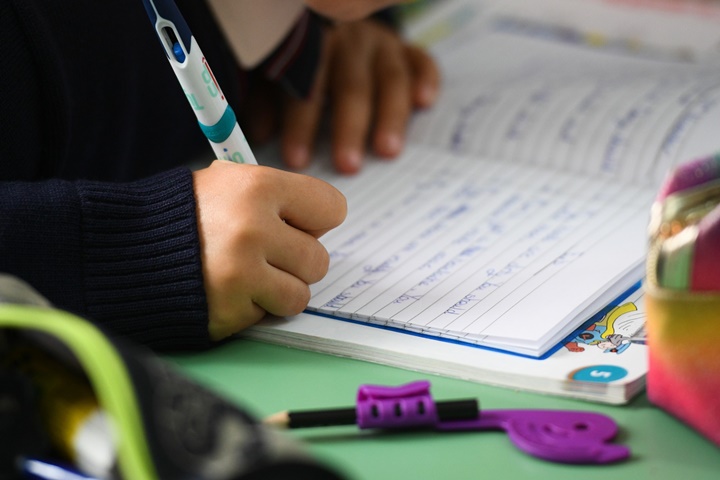
Early school leavers in Malta is measured at 22.6, the second highest behind Spain at 24.9. Early school leavers face a higher risk of social exclusion and poverty, according to research, and societies need to strive to reduce the number of young people in this situation.
There is no clear correlation between GDP per capita and the proportion of early school leavers: while most of the western and northern Member States have high GDP per capita and shares of early school leavers lower than the European average, the lowest shares of early school leavers have been achieved in a group of Member States mostly in the central and eastern EU, all with lower GDP per capita.
The gender pay gap in Malta is 6.1 and represents the difference between average gross hourly earnings of male paid employees and of female paid employees as a percentage of average gross hourly earnings of male paid employees.
Long term unemployment is reported as 3.0 in Malta and is the share of those who have been unemployed for 12 months and more in the total active population (employed and unemployed).
GDP per capita in PPS is shown as 21 900 in Malta. PPS is a common currency that eliminates the differences in price levels between countries allowing meaningful volume comparisons of GDP between countries.
Two examples from health and education, which are important determinants of the quality of life of individuals, are presented below.
Life expectancy in Malta is 80.9 years. The overall health level of a society is related to its GDP, but the correlation becomes weaker after a certain level of economic development is reached. Based on the relation between the two, EU Member States can be broadly divided into three groups.
Those in the central and eastern EU have relatively lower life expectancy and relatively lower GDP per capita. Those in the southern EU, have a higher GDP per capita and a life expectancy which reaches the highest values, while those in the western and northern EU have the highest GDP per capita, but life expectancy at around the same level as in some of the southern Member States, or even slightly lower.
Eurostat’s 8 + 1 quality of life dimensions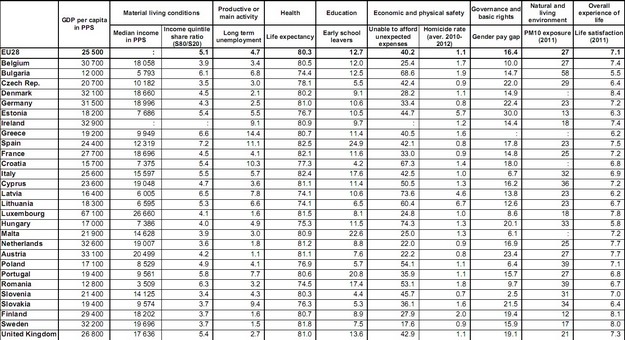
Life expectancy and early school leavers are only two of the indicators that are included in Eurostat’s framework for measuring quality of life, on which the online publication, presenting a detailed analysis of the 8+1 dimensions, is based.
The first 8 dimensions, which encompass both objective factors and subjective perceptions, are: material living conditions, productive or main activity, health, education, leisure or social interactions, economic & physical safety, governance & basic rights and natural & living conditions These are complemented by 1 dimension measuring the perception of overall experience of life.