Be the first to comment!
MEPs and Students debate held on the University Campus
 Email item Email item
|  Print item Print item
|
|
MEPs and Students debate Open Internet, Data Protection, Terrorism and Migration – on University Campus.
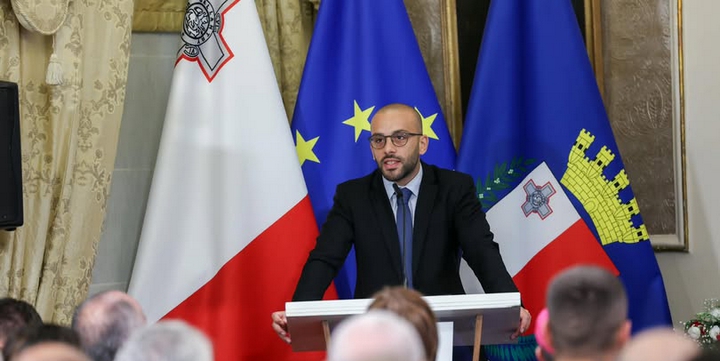
Today the European Parliament Office together with KSU organised a debate with MEPs Therese Comodini Cachja and Marlene Mizzi and students on University Campus.
Dr. Peter Agius, Head of the European Parliament Information Office opened the debate by introducing the mission of the office to communicate Europe based on the interests of stakeholders, businesses and students in Malta.
"The aim is to close the democratic circle between the decision makers in the EU and those that are meant to make the tools of the Union work for themselves, at the work place or in any other aspect of daily life," he said.
A law student asked on how will the EU ensure a balance between data protection and anti-terrorism. Mentioning the Passenger Name Record decision taken at the EP last week he asked why this had to take 5 years.
Marlene Mizzi stated that PNR discussions have indeed been going on in the European Parliament for the past 5 years. This delay was due to the fact that there were multiple controversial issues under discussion between the EP groups.
Therese Comodini Cachia stated that the EU needs to address terrorism without weakening or erasing the rights and freedoms that the EU has achieved for its citizens. "The PNR is only one method on how to address the issue of terrorism," she said.
Comodini Cachia stated that the defence sectors worldwide must agree and put aside national pride and acknowledge that terrorism is a worldwide threat and not merely an EU one, and therefore must be treated in unison. "This is the first step to a final solution to terrorism which we have no yet reached," she stated.
The PNR regulation was approved in conjunction with a report on data protection and another on criminal investigation, thus keeping a balance between the three factors.
Another student from the ICT Faculty was concerned about the dark net, and the Internet usage within the EU in general. Is it enforcing restrictions on internet usage, or is it safeguarding a free-to-use space?
MEP Comodini Cachia said that she believes that the Union needs to take a clear stand that Internet is not owned by government, companies or a particular stakeholder, but pertains to all stakeholders equally and above all, to the citizen. Hence, every measure at EP level must be first consulted with all these stakeholders. The MEP made a reference to the Internet Governance Forum under the auspices of the UN.
Marlene Mizzi stated that, "democracy does not allow for the control of internet in any way thus work on the Digital Single Market promotes the demolition of barriers to internet access, doing away with geo-blocking and ensuring portability of digital content between Member States."
MEP Mizzi also highlighted the ongoing debate at the EP on the right to be forgotten on search engines.
A student active in JEF (Young European Federalists) asked MEP Mizzi about her recent statements that solidarity and burden-sharing are buzz words unless followed up by real commitment.
MEP Mizzi, who was the shadow rapporteur on the recent EP report co-authored by MEPs Metsola and Kyenge on a holistic approach to migration, answered that "the report offers solutions for the current scenario but it will remain dead word unless followed up by a real commitment towards implementation in the Member States."
Mizzi also insisted that the root causes of migration are far from being addressed, mentioning the billions of EU aid not tied to real investment in infrastructure investments in Africa.
MEP Comodini Cachia then answered a question by a European studies student, who asked about the digital single market, and how this effects students in a way that they can use it for educational reasons and to unleash the potential of Malta.
Comodini Cachia stated that there are many obstacles for Malta despite recent developments such as the sale of items on Amazon which are now open to Maltese businesses.
"The problem of selling from an island country such as ours is that Maltese businesses incur higher costs due to different postage charges, making it even difficult for consumers in Malta to fully benefit from international markets. This discrimination needs to be addressed even regarding the redirection to other platforms with higher prices when accessing a website from different IP origins."
Marlene Mizzi also outlined the work by the EU in collaboration with Google on a Campus London which provides unlimited support for startups to open up to a market of all 28 Member States.
Another student following a course in international relations asked on the rise of extremist parties in the EP and the threat that these might pose to the application of human rights in the Union in the future. MEP Mizzi replied that unemployment and marginalisation leads to radicalisation and that ''the rise of extremist parties are our failure of not bringing out the best of Europe.''
Closing off the debate, KSU President Rebecca Micallef addressed the issue of student activism in European politics and European affairs and outlined how today's active debating was indeed a reflection of its on going growth.