 1 comment.
ERA’s Legal Notice on Dwejra represents grave threat to site’s scientific value – Academics
 Email item |  Print item |
|
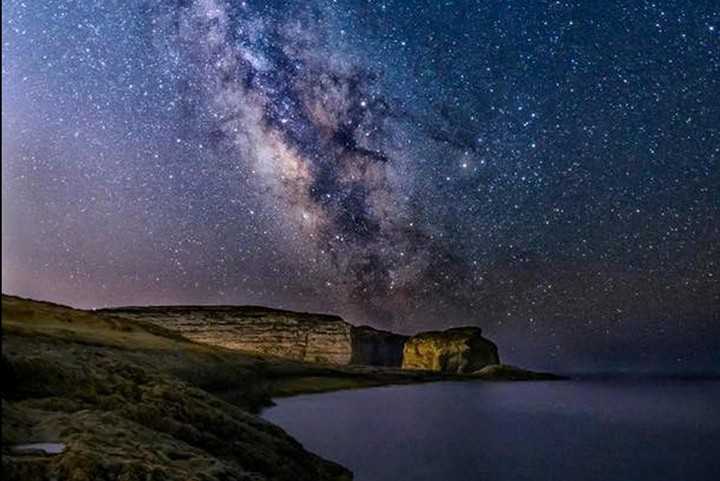 Academics from the Department of Physics, the Institute of Space Sciences and Astronomy, and the Chamber of Scientists, have said that the Environment and Resources Authority’s Legal Notice on Dwejra represents a grave threat to this site’s scientific value.
In a joint statement, stressed that Dwejra, in Gozo, has long been a site of exceptional value for scientific education and research. “As light pollution has continued to intensify across the Maltese Islands – largely as a result of inadequate regulation of exterior lighting – Dwejra has endured as one of the very last refuges of natural darkness, and the most significant remaining site where high-quality astronomical observations can still be carried out for both research and educational purposes.”
The academics pointed out that over the years, this site has been actively used by university students undertaking their research projects. Dwejra has contributed substantially to the training of future scientists: “it inspired them, and it provided a rare observational window through which they could study the Universe directly.”
Beyond academia, they noted that Dwejra has been invaluable for public education and outreach. It has enabled meaningful engagement with the wider community, particularly with young children, many of whom experienced a truly dark, starry sky there for the first time. “Such experiences foster curiosity, imagination, and a deeper interest in science – prompting questions about stars, galaxies, and the nature of the Universe itself.”
It was our expectation that this legacy would be preserved. Sound stewardship demands that sites of such rarity and value be protected with the utmost care. It is both reasonable and necessary to expect that an area designated for environmental and cultural protection would not be compromised – least of all by the very authority entrusted with its safeguarding.
The academics stated that “regrettably, the new legal notice issued by the Environment and Resources Authority (ERA) effectively signals the end of Dwejra’s night sky as a scientifically viable dark site.”
They argued that “by permitting lighting until midnight, the notice directly contradicts the Gozo and Comino Local Plan, which explicitly designates Dwejra as a Dark Sky Heritage Area under Policy GZ-DARK-1. This decision runs counter to established scientific evidence, best practices in nature conservation, and the broader public interest.”
The night sky is a shared natural and cultural heritage. While other countries are actively working to protect and gain international recognition for their dark skies, “Malta is moving in the opposite direction – diminishing and irreversibly degrading one of its last remaining natural assets,” the academics said.
They concluded by urging the responsible Ministers and ERA “to reconsider and reverse this decision. The only scientifically sound, logically consistent, and ethically defensible course of action is to ensure that no artificial lighting is permitted at Dwejra at any time. Anything less represents an unacceptable loss to science, education, and our shared heritage.”
The statement is signed by: Department of Physics, Institute of Space Sciences and Astronomy and the Chamber of Scientists.
Next Friday, the 20th of February, at 7pm, the Astronomical Society of Malta is organising a public observation night at Dwejra in Gozo to raise awareness of why Dwejra must remain dark. Everyone is invited to attend.
Objections against the Legal Notice can be made to era.policy@era.org.mt by the 3rd of March.
File photo


















The primary reason for the strict lighting controls at Dwejra is that it is a Natura 2000 site and a designated Dark Sky Heritage Area. This isn’t just a fancy title; it comes with specific legal and ecological protections:
Shearwater Nesting: Dwejra is a major nesting site for the Scopoli’s and Yelkouan Shearwaters. These seabirds are extremely sensitive to light. Artificial light disorients the fledglings, causing them to crash into cliffs or inland structures instead of heading to sea.
Astronomy: Because of its geography, Dwejra is one of the few places in the Maltese Islands with low enough light pollution for serious stargazing and astronomical research.
?Biodiversity: Many nocturnal species in the surrounding cliffs depend on a natural light cycle to hunt and survive.
Dwejra offers a rare biological “treat”: it’s one of the few places where your rhodopsin can fully regenerate and your ciliary muscles can completely let go. It’s not just “dark”—it’s a recovery zone for your sensory system.
No lights ever please..