Be the first to comment!
Are MPAs an alternative to traditional fisheries management?
 Email item Email item
|  Print item Print item
|
|
The Department of Fisheries and Aquaculture (DFA) and the Department of Biology (DoB) at the University of Malta (UM), and, have recently joined forces on an international research project called ‘Marine Protected Areas Network Towards Sustainable Fisheries in the Central Mediterranean (MANTIS).
“Most of the fisheries in the Mediterranean target overfished stocks. Besides the biological impacts of the activity, this unsustainable practice also means that fishers cannot maximise their income,” the University of Malta has said in a statement.
To increase the productivity of the fished species, a key requirement is a shift of the size of the first capture to larger sizes.
The UM added that, “increasing the mesh sizes of nets used by fishers to avoid catching juveniles of certain species, for example Hake and Red Mullet in the case of trawl nets, is not always possible since this would also result in lower catches of valuable small-sized commercial species, such as the valuable Giant Red Shrimp, the deepwater Rose Shrimp and Norway lobster.”
It pointed out that, “an alternative management strategy is to reduce catches of juveniles by protecting the nursery habitats where they aggregate, through the establishment and implementation of Marine Protected Areas.”
The research project noted that “restricting fishing activities in such areas ensures that habitats which are essential for species to complete their life cycles are protected, that the amount of small individuals in catches decreases, and that more fish and shrimp survive to reproduce. Ultimately, this will lead to higher catches and more sustainable fishing.”
The MANTIS project aims to protect habitats that are critical for commercial species and identify measures to minimise adverse fishing impacts within areas where juveniles of commercial species aggregate.
The MANTIS project is funded by the European Commission DG Maritime Affairs and Fisheries (DG MARE), and coordinated by the Italian National Research Council (CNR). Apart from the two Maltese participants, the MANTIS project consortium includes the Italian National University Consortium for Marine Sciences (CoNISMA), the Italian National Institute of Oceanography and Experimental Geophysics (OGS), the Croatian Institute of Oceanography and Fisheries (IOF), the cooperative for Fisheries and Aquaculture Economic Research (Nisea), the World-Wildlife-Fund (WWF), and Oceana.
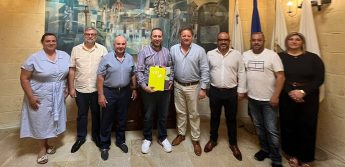
Participants recently met at the MANTIS project first General Meeting in Rome to discuss project activities.
In the coming months, the scientific collaboration between the DFA (represented by Ms Roberta Mifsud and Ms Marie Louise Pace) and the DoB (represented by Dr Leyla Knittweis-Mifsud and Prof Joseph A Borg), will focus on reviewing and integrating all available knowledge on the space-time dynamics of Maltese fisheries resources.
All available data on the locations of catches, and even more importantly on the sizes of individuals of the fish species caught from the different fishing grounds, will be gathered by the local teams.
Such information is available from on-board observations carried out routinely by the DFA, from past scientific research projects, and ongoing scientific surveys.
The Project said that once analysed, the information will enable investigation of how a network of Marine Protected Areas can contribute to improve sustainable fisheries in the Central Mediterranean, and ultimately aid local fishers to maximise their incomes.
Photos: Maltese trawl fisher sorting his catch. Leyla Knittweis-Mifsud © DFA – MSDEC; Hake (Merluzz). OCEANA © LIFE BaHAR for N2K and Nephrops (Langostini). OCEANA © LIFE BaHAR for N2K